
A foundation is the base of every holiday cabin – both literally and figuratively. However, there are many different techniques for preparing the groundwork for a future timber-frame structure. Which one should you choose? What kind of foundation will work best for a timber-frame wooden cabin or a wooden garden gazebo? How much will it cost, and which option will be easiest on your wallet? And can you prepare the foundation for a holiday cabin or a tool shed yourself? We have the answers.
A house on blocks: a pier foundation made of concrete blocks
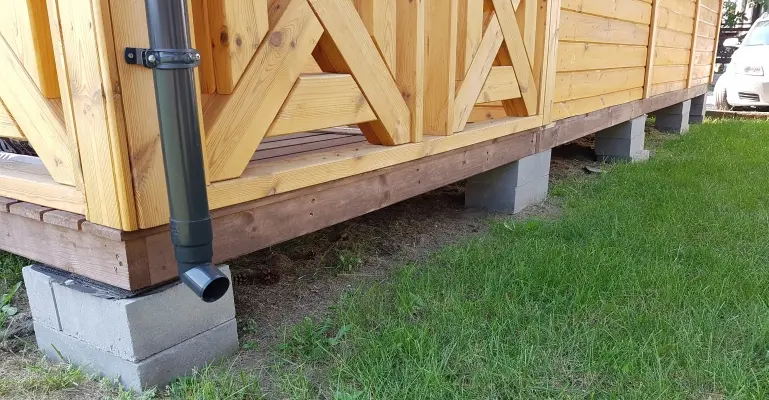
The foundation for a timber-frame house, a wooden holiday cabin or a gazebo can be made of blocks – this is the easiest and quickest type of foundation to prepare. Concrete blocks, known as betonites, are resistant to moisture and compression, among other things. They are placed at key points across the whole footprint of the structure (both around its perimeter and along the floor joists), spreading its weight evenly. They also make it easy to correct uneven ground (by stacking several betonites on top of each other).
Concrete blocks made of B15, B20 (the most popular option) or B25 concrete are widely available at retail, so you can easily build the foundation yourself. The blocks come in various sizes (38cmx25cm, 38cmx14cm, 38cmx12cm), and they usually weigh no more than 30 kg. How much does such a foundation cost? The cost of a concrete block foundation ranges from 40 to 60 PLN / m2. Of course, labour costs must be added to that.
It is worth remembering, though, that you can order such a foundation from us, built (and levelled) to the height of one block (12 cm). And that comes at no additional cost. All you need for this type of foundation is stable, reasonably level ground, although it is worth considering hardening it beforehand with crushed stone and stone chippings as a precaution.
Pier foundation made of formwork tubes
A pier foundation made of formwork tubes is a slightly sturdier alternative to a pier foundation made of concrete blocks. It is inexpensive, and foundations of this type are simple to prepare.
Building a foundation from formwork tubes involves placing cardboard formwork tubes, easily available at DIY stores, into holes dug in the ground beforehand, and then filling them with concrete. The tubes do not have to reach the very bottom of the hole – they only need to stay vertical and, above ground, form a common level. However, getting the foundation perfectly level can be tricky, so it is worth getting professional help with this. A formwork tube foundation is worth considering especially when the ground has an unknown load-bearing capacity or is significantly uneven. Drewnolandia does not offer installation of this type of foundation.
Concrete slab, or a reinforced foundation slab
A reinforced foundation slab is the most solid solution, but also the most expensive of all those proposed. A reinforced concrete slab reaching 20-30 cm into the ground ensures complete stability of the structure resting on it. Another advantage is the relatively short preparation time – after 7 days at most, the slab is ready for use. How do you make a foundation slab? Unfortunately, it is a difficult task to do yourself, and professional help will be necessary. However, on ground with low load-bearing capacity, the slab often turns out to be the only right solution, especially for larger structures and those designed for all-year use.