
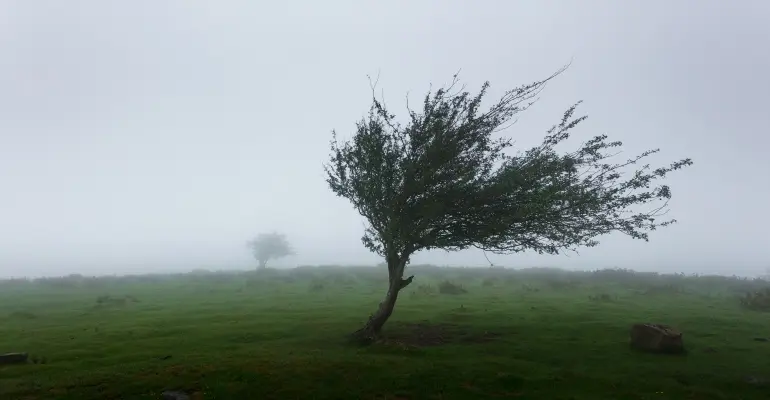
Around Canadian-style timber-frame homes over the years many myths have grown up among potential investors, spread like a game of telephone. One of these myths, returning like a boomerang and most often asked of us, concerns tying the cabin to the ground and fears that a strong wind could carry it away. How much truth is there in this tale? Can a cabin really be shifted by gusts of wind? We’re here to clear things up!
Common sense
It’s hard to pinpoint the source of this myth, but its persistence is fueled by associative thinking. In common sense, a masonry structure feels powerful, heavy, solid, and capable of withstanding even the most extreme weather. Wood, on the other hand, is associated with lightness, may seem flexible and brittle. Few people have a proper idea of the real weight of solid wood, especially after drying, which drives out natural sap, and after the rest of the processing. To give a clearer picture: one of our smallest products – the Ewa gazebo measuring 3 m x 3 m – when assembled almost entirely from posts, roof structure, and lattice decorations, weighs about 850 kilograms in total! By way of illustration – that’s more than a Fiat Seicento. A recreational cabin, whether we’re talking about a small garden house with a total area of 15 m2 including a terrace, or a substantially larger structure up to 35 m2, still weighs several tons of truly heavy timber in C24 class construction. Something that even the strongest gusts of wind cannot move.
But my place really does have strong winds!
Increasingly frequent weather anomalies in Poland, such as gusts and hurricanes, understandably worry potential investors. In many parts of the country, it can blow quite hard at times, yet all our completed projects so far stand up to the elements without any trouble. We have already built in every corner of Poland, including along the coast where powerful storm winds struck, or in the Western Carpathians where dangerous halny winds appear. The secret lies not only in the actual weight of the wood, which is simply too heavy for the wind to threaten stability, but also in the Canadian-style construction, which prevents damage to individual cabin components. Vertical structural bracing in the frames is spaced densely enough to keep the cabin intact no matter the weather outside.
Anchors, rods, screws
However, many investors are not satisfied with the assurances from manufacturers, and still want to implement a contingency plan – anchoring the cabin to the ground. Ideas vary – embedding rods into the soil, fastening to point foundations with steel straps, or even screwing into concrete foundation blocks. Generally, most of these solutions miss the mark. They create extra work for the investor that rarely pays off and more often hinders installation, later removed by the building crew. There are several reasons; misplacing potential rod or anchor locations relative to key cabin components is just one. Most importantly, these cabins simply do not require anchoring. The closer they fit to prepared foundation points, the better for them. Therefore, any metal distances will not positively affect the stability of the entire structure. If an investor truly wants to professionally secure the cabin to the foundation, they should first prepare solid foundation beams tied to the slab, and only then attach the cabin structure. Fortunately, in local climatic conditions there are no major obstacles to such actions, and wooden cabins retain full stability, simply resting on the prepared foundation.
Tornado versus a timber-frame cabin
Of course, there are natural phenomena you cannot counter even with the most modern technological solutions. One rare force in Poland is a tornado. A vertical column of wind with enormous power can grab or destroy almost any obstacle, and homes of all kinds are no exception. Paradoxically – and this may sound unbelievable to supporters of brick-and-mortar solutions – Canadian-style cabins often withstand a collision with this phenomenon better than brick houses. The key is the whole structure being tied together. While a wooden roof covering a brick house is attached to it only by a tie beam, a timber-frame “Kanadyjczyk” is a solid, interconnected construction where all elements are joined. Putting extreme examples aside and answering the question in the title – will wind carry away my cabin? No, it certainly won’t.