
You probably know that in all our projects, whether they are all-year homes, wooden holiday cabins, garden gazebos, or other structures, we consistently choose high-quality C24 wood, chamber-dried. We go into more detail about this in the article Which wood do we use in the production process?. But do you know exactly what chamber drying of wood entails? In the following article we discuss how to dry wood, what a chamber wood dryer is, and which drying technology guarantees the best results. We invite you to read!
The most popular wood drying methods
Until recently, the wood preparation process involved seasoning—storing for several years and slow, natural drying. This natural drying is simple and inexpensive, but it does not eliminate pests and fungi that may be in the wood. Material subjected to seasoning would thus require additional protection with suitable products—for example, a wood preservative.
The wood drying methods available today offer not only greater effectiveness but also shorter drying times. Among the popular methods in this regard are:
convection methods, including drying:
- in air- and exhaust-gas dryers without burners,
- using superheated steam or other vapors,
- in liquids (often used for sawn timber—here mainly creosote oil and petrolatum)
electrical resistance drying methods
- quick but expensive, they allow a significant shortening of drying time, but also change the physical and mechanical properties of the wood, so they are not the best solution for structural wood
chemical drying methods
- to the water present in the wood add urea, glycerin or glycol solutions
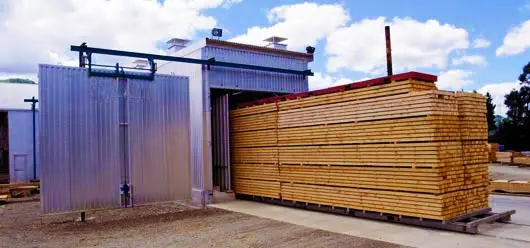
Nowadays, an increasingly common solution is the so-called chamber drying of wood. The drying process in this case is relatively fast, taking only a few days, and it uses chamber kilns.
What does chamber drying of wood involve?
The chamber drying of wood proceeds in a special kiln at very high temperature, which purges the wood, effectively eliminating all pests and fungi. As a result, wooden elements, such as the framing of our Canadian-style houses, no longer require additional protection. However, wooden elements exposed to weather should be protected best with appropriately chosen wood preservatives. Wooden gazebos, carports, or holiday cabins should be treated with suitable preservatives. You can read more on this in the article Do houses and wooden structures need protection?
The modular construction of chamber dryers allows precise, individualized adjustment of drying parameters, for example to different wood species, or its thickness (the ability to dry wood across a wide range of moisture content). This drying yields truly excellent results.
Chamber drying technology is widely used in countries such as Canada and the United States, as well as in Scandinavia (where weather conditions can be harsher than in Poland). We are glad to contribute to its popularization in Poland.