A rock garden is a great way to make use of difficult terrain and add an interesting decorative feature. These compositions resemble a mountain landscape and fit beautifully into garden designs. They are relatively easy to maintain – the plants have modest requirements, and the most important tasks are weeding and occasional pruning. Before you plant the first plants, though, it pays to prepare the site well and learn how to build a rock garden step by step.
Rock garden ideas – what are your options?
A rock garden is not just a pile of stones planted with assorted greenery. It is a stylized miniature of, for example, a mountain massif. Naturalistic rock gardens are strict in this respect, while in home gardens different styles and philosophies are most often combined.
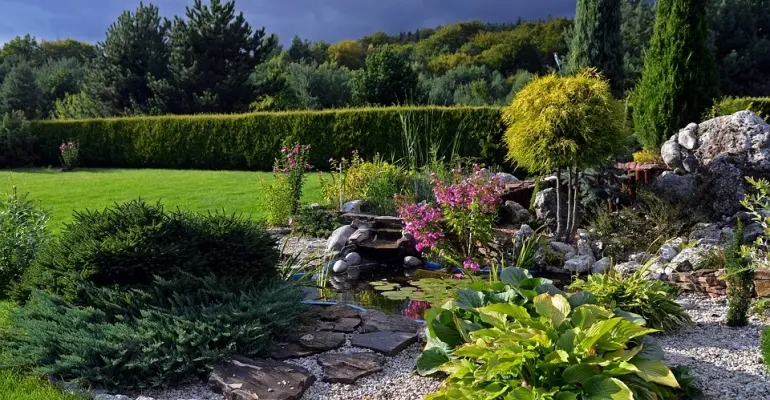
A rock garden very often takes the form of a flat rockery bed, but it can also imitate mountain slopes and create an alpine landscape in your garden. It can be freestanding (for example, set on a lawn), but the best effect is achieved when it adjoins another feature: a dry stream, a recreation area, a fence, a holiday cabin or the wall of a house. A rock garden can also be integrated with a garden pond or placed along its edges, which further enhances the visual appeal of the design. An interesting option is a scree garden, which imitates natural mountain ecosystems – scree forms as a result of rock weathering.
It should be built on slightly sloping ground, only in sunny spots. If the terrain's variation allows, you can try building a ravine. At its base it is worth heaping up stones that imitate a mountain stream, and planting greenery on the elevated parts. On poor, infertile, stony ground, a good solution is to create a mountain meadow. Combining plants with different requirements and appearances lets you create interesting garden rockeries.
A small rock garden – solutions for compact spaces
A small rock garden is a great way to bring a mountain feel even to the tiniest garden. Such designs work well on flat ground, in the corners of a plot or next to house walls, where there is no room for extensive compositions. The key is choosing the right plants – creeping plants such as creeping jenny or ground ivy work best, as they quickly cover the surface and give the rock garden a natural look. It is worth choosing small but striking stones that harmonize with the character of the garden and won't overwhelm the composition. A small rock garden can be built on a modest rise or directly on flat ground – it all depends on the available space and your personal preferences. This miniature form of rock garden lets you enjoy the beauty of plants and stones even in a limited space.
How to build a garden rock garden?
Building a rock garden step by step requires proper site preparation and careful planning.
Site preparation and drainage
The first step is choosing the right spot – ideally sunny and slightly sloping. Next, clear the area of turf and weeds and remove the topsoil. At the bottom, it is worth laying a drainage layer – this can be made of rubble fragments, coarse gravel and larger stones. This way water won't stagnate, and the plant roots will have access to air.
Placing the stones and shaping the form
On the prepared ground, you can heap up a mound of fertile soil mixed with sand. This is the moment to plan the final shape of the rock garden. The largest stones should be set in place or lightly sunk – to about 1/3–1/4 of their height – which gives the composition a natural look. Between the large stones you can gradually add smaller ones, stabilizing them with soil.
Substrate and landscape fabric
Once you have shaped the body of the rock garden, cover it with a mixture of garden soil and sand, making sure it drains well. At this stage you can lay landscape fabric – it limits weed growth and makes later maintenance easier. The fabric is covered with decorative gravel or small stones, and plants are set in by cutting X-shaped openings in the material.
Planting
The last step is choosing and arranging the plants. Compositions made up of groups of a single species, arranged in layers – low ones at the front, taller ones at the back – will look best. Plant in the spaces between stones, where the soil is slightly sunken. After planting, it is worth watering the plants generously and monitoring their condition for a few days. For better overall stability, it is a good idea to wait 2–3 weeks before the final additions to the composition.
Principles of building and designing a rock garden
A rock garden is meant by design to decorate the garden while causing as few problems as possible. To be a true showpiece of your green corner, it should be built thoughtfully.
It is worth following the tips below.
Limit the types of stone
You should use one, or at most two, types of stone to build a rock garden. An excessive mishmash of building materials, as well as greenery, doesn't make a good impression – quite the opposite. It also looks unnatural. The choice of stones should match the character of the garden so that the whole looks cohesive.
Avoid pebbles – go for sharp shapes
Stones with fairly sharp shapes are preferred in rock gardens. Such rock gardens better imitate mountain massifs and other alpine areas. Commonly used river pebbles actually suit a dry streambed better.
Stones aren't everything – plants play the leading role
Stones should not make up more than 50% of the rock garden's surface. Plants play an important role in it. For a rock garden to have "character", it should include at least a few large stones that stand out in size. It is worth planting plants of the same species in groups, which creates a harmonious effect. When choosing plant species, pick suitable plants adapted to the conditions of the site. Combining plants with different requirements, seasonality and appearance lets you create an interesting composition. The plants that work best in a rock garden are sun-loving plants, perennials, evergreens, conifers, creeping conifers, shrubs, pines, Lawson cypress, bugleweed, rock cress, cheddar pink and Carpathian bellflower. The composition is completed by flowers with different blooming times, ornamental plants and tall plants.
A rock garden needs sun – avoid large trees
It is better to avoid building a rock garden near large, spreading trees that would shade it excessively.
Wild corners – a place for beneficial reptiles
In one spot in the rock garden you can lay a pile of stones of various sizes, as long as you don't overdo it. It can be a basking place for beneficial reptiles – the garden's resident tenants.
Plants for a rock garden
Choosing plants is one of the most important stages of planning a rock garden. It is worth opting for drought-tolerant, sun-loving species that thrive in poor, well-drained soil. Here is a breakdown of plants by type:
Perennials and ground cover plants
These are the foundation of every rock garden – they are low, spread outward and fill the spaces between stones well. Good choices include:
- common houseleek,
- biting stonecrop and Caucasian stonecrop,
- bristle-leaved sandwort,
- sea thrift,
- evergreen candytuft,
- saxifrage,
- cheddar pink,
- bugleweed.
Bulbs and seasonal plants
They bring color and seasonal variety – they bloom in spring or autumn, bringing the composition to life:
- crocuses (spring and autumn),
- snowdrops,
- tulips,
- autumn crocuses,
- California poppy.
Shrubs and trees for a rock garden
They add distinctiveness and structure. It is best to choose dwarf and slow-growing varieties that won't dominate the whole composition:
- creeping juniper,
- dwarf mountain pine,
- barberries,
- cotoneaster,
- euonymus,
- mezereon,
- cinquefoil,
- spirea,
- silver birch (miniature varieties).
Evergreen and coniferous plants
They let you enjoy greenery all year round. They thrive best in sunny spots:
- creeping conifers (e.g. junipers, yews),
- Lawson cypress,
- mountain pine (pinus mugo),
- dwarf Japanese larch.
Rock garden care
For a rock garden to delight with its appearance throughout the season, regular care is essential. Above all, weeds should be removed systematically, as they can compete with ornamental plants for water and nutrients and spoil the look of the composition. Plants in a rock garden usually don't need frequent watering, but during dry spells it is worth making sure they get enough water, especially young specimens.
In spring and summer it is a good idea to feed the plants with fertilizers designed for ornamental plants, which ensures lush growth and abundant flowering. In winter, it is worth protecting more delicate species by covering them with landscape fabric or conifer branches to shield them from frost. Thanks to these simple measures, your rock garden will stay healthy and attractive all year round.
The most common mistakes when building a rock garden
Building a rock garden requires a thoughtful approach, and some mistakes can significantly affect the result. One of the most common problems is poor plant selection – not all species tolerate the conditions in a rock garden well, so it is worth choosing those adapted to dry, sunny sites or partial shade, depending on the location. Another mistake is skipping the drainage layer – without it, water can stagnate and roots can rot.
It is also worth remembering that not all plants tolerate full sun, so check the requirements of your chosen species before planting. Regular care, including weeding and checking the condition of the plants, is the foundation for a rock garden that delights for years. Avoiding these mistakes will make your rock garden project a success, and your garden will gain a distinctive character.
Safety when building and using a rock garden
Safety during the construction of a rock garden and its later use is an issue that should not be underestimated. Earthworks and stone laying should be carried out with care, especially on embankments or in places prone to erosion – securing the edges of the rock garden properly will prevent soil and stones from sliding. It is worth regularly checking the stability of the structure, especially after heavy rainfall or winter. If children play in the garden or pets spend time there, make sure they don't have free access to the steep parts of the rock garden, which helps avoid dangerous accidents. A well-thought-out build and attention to its technical condition guarantee a garden feature that is not only beautiful but also safe.
A finished rock garden design is not just a garden decoration, but also the satisfaction of a composition you created with your own hands. Choose your favorite plant species, create interesting, irregular shapes and work step by step – the result will surely surprise you. If you're looking for more inspiration, be sure to check out our other gardening guides!
FAQ
When is the best time to build a rock garden?
The best time to build a rock garden is spring or early autumn – the soil is moist then, and plants establish well. Avoid the hot months and hard frosts. This way the plants will root faster and begin to grow.
Can ornamental grasses be added to a rock garden?
Yes – ornamental grasses complement a rock garden beautifully, adding lightness and movement. It is worth choosing lower varieties, e.g. blue fescue, sedge or fountain grass. Plant them in groups to create cohesive accents.
What stones are best for a rock garden?
It is best to choose natural stones with sharp edges – e.g. sandstone, slate or granite. Avoid too many types at once – one or two are enough to keep it cohesive. Gaps between large boulders are best filled with smaller stones.
Does a rock garden have to have a specific shape?
Definitely not – the more irregular the shapes, the more interesting the effect. Natural asymmetry imitates a mountain landscape better and gives you more freedom in planting. It also makes it easier to fit the design to your plot.
How to plan a rock garden project in a small space?
In small gardens, it is worth choosing low perennials and creeping plant species, along with a few striking stones. Such a rock garden project can be set in a corner of the plot, by a house wall or along a path. The key is limiting the number of elements and a well-thought-out layout.