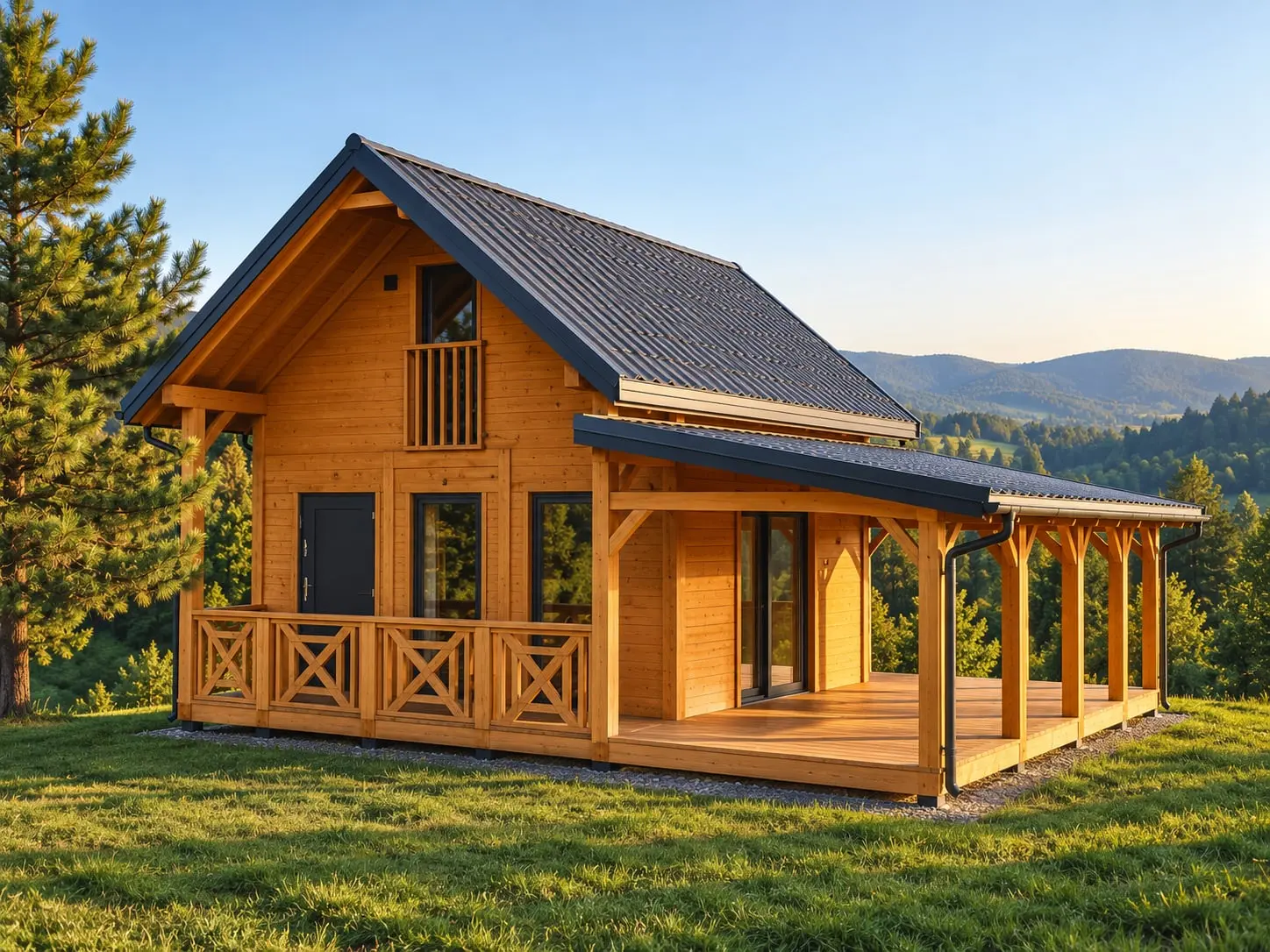
Dreaming of turning your holiday cabin into an all-year home you can enjoy well beyond the summer? Before you decide, find out which formalities you need to complete and what it costs to convert a holiday cabin into a residential one. In this article, we explain who benefits from the conversion, which conditions must be met and how the process works step by step. Happy reading!
Converting a holiday cabin into an all-year home – why is it worth it?
First of all, it's worth stressing that converting a holiday cabin into an all-year one isn't just for people planning to leave their city flat for good. An all-year cabin gives you far more options. Imagine that you can work remotely and, at any time of year, move for a few days to a completely different setting. Think of all the celebrations and parties you could host there – even in winter. Christmas or New Year's Eve in a wooden cabin with atmospheric decorations and hundreds of twinkling lights? Winter holidays with the kids outside the city? It's all possible, as long as the building is suitable for year-round use.
What should you keep in mind when building a holiday cabin to make a later conversion into a residential one easier?
If you're considering this scenario, it's worth thinking from the very start about a few elements that will greatly simplify any future change of the building's use.
1. Floor insulation and a structure prepared for it
In a holiday cabin, especially a timber-frame one, floor insulation is the hardest thing to add once the building is finished. That's why it's worth planning it already at the shell stage. This will make it easier to later bring the structure up to the standards required for residential buildings. It's also a good idea to use materials that are highly resistant to moisture and rodents right away.
2. Double-chamber uPVC windows
If you want the cabin to work as an all-year home, you'll need windows with high thermal insulation. Instead of fitting single-pane windows, it's better to choose uPVC models with triple glazing right away, designed to meet the requirements of all-year homes.
3. Insulated doors
Like windows, the front door plays a big part in thermal comfort. The versions typical of recreational cabins are usually unsuitable for winter use. It's better to invest straight away in a thermally insulated door, which can also serve as a burglary-resistant door and improve security.
4. Provision for heating systems
Already at the design stage, you should allow space for heating systems – for example a wood stove, a small fireplace, an electric heater or an air conditioner with a heating function. It's an investment that makes a future conversion for residential use much easier.
5. Routing of plumbing and electrical installations
Although a holiday cabin doesn't need extensive installations, if you're planning to convert it into a residential building in the future, you should plan the layout of the plumbing and electrical systems from the start. Even if they aren't fully commissioned right away, it's worth preparing pipe penetrations, cable routes and structural reinforcements for a water heater or shower. This is especially important if the plot is large enough and a connection to the water and sewage network is possible.
6. Space for storage and year-round use
If you're thinking of turning the cabin into a self-contained home, it's also worth providing suitable utility space. A small tool shed, storage under the roof or a built-in wardrobe will come in handy for garden equipment, seasonal items or fuel. Once the cabin becomes a year-round place to live, such conveniences will be indispensable.
Applying these solutions already at the planning stage can significantly reduce the future cost of converting a holiday cabin into a residential one. Such measures are especially important if you plan to apply for a change of the building's use and to enjoy your plot in every month of the year.
How to legally convert a holiday cabin into an all-year home?
Before starting any construction or installation work, you need to check whether changing the use of a holiday cabin to an all-year residential home is possible at all under the regulations.
Step 1: Checking the local spatial development plan (MPZP)
To begin with, take a look at the local spatial development plan, which defines what functions buildings in a given area may serve. If the plan allows all-year residential development, you're on the right track.
However, if no MPZP has been adopted for your plot, or the plan doesn't provide for all-year development, you must apply to the municipal office for development conditions, which will make a formal change of the building's use possible.
Step 2: Notifying the change of use of the building to residential
Once you know that the cabin's location doesn't rule out its conversion, you'll need to notify the county office (architecture and construction department) of the change of use from a recreational building to an all-year residential building. The notification must include:
- a description of the building's current and intended use,
- technical documentation (including drawings and structural data),
- the location relative to neighbouring plots,
- often also a technical expert's report, especially in the case of an extension or major structural changes.
All documents should be prepared by a specialist with design and construction qualifications, such as an architect.
If the office raises no objection within 30 days, this is treated as tacit consent and you can start the conversion.
Step 3: Adapting the cabin to year-round conditions
For a holiday cabin to be recognised as an all-year residential home, it must meet certain technical and living requirements. In practice, this means:
- thermal insulation of the floor, walls and roof – in line with current thermal protection standards,
- installation of uPVC windows with double glazing and steel doors with thermal insulation,
- a heating system, e.g. a fireplace, wood stove, heat pump or air conditioner with a heating function,
- connection of electrical, water and sewage installations – ideally, the design should include the option of connecting to the local network or using alternative solutions (septic tank, well),
- a suitable interior layout that allows comfortable living all year round (e.g. a full-size kitchen, a bathroom with a water heater, storage space).
Step 4: Verifying the plot area and the building's parameters
When the status of a cabin changes, officials may also check whether the plot area and the building's position meet the standards for an all-year single-family home. Make sure that the distances from the plot boundaries, neighbouring buildings and utilities comply with technical and building regulations.
How to convert a holiday cabin into an all-year one?
The conveniences listed above are not enough to fully adapt a home for multi-season use. The conversion must also cover the following elements:
- thermal insulation - will allow you to use the house even in the coldest months of the year. The floor, walls and roof must all be insulated. Keep in mind that insulation protects not only against the cold, but also against excessive heat in summer. An insulated wall consists of cladding boards, a wind barrier membrane, mineral wool filling the frame and a vapour barrier membrane. Together with uPVC windows and steel doors, the wool provides full insulation for an all-year home;
- electrical installation - consists of electrical wiring run through the cabin's frame, sockets, light switches and bulb holders led out from the ceiling;
- plumbing installation - plastic pipes are needed, run to the washbasin, shower and toilet, as well as the sinks in the bathroom and kitchenette;
- heating - an all-year cabin can be heated in several different ways. The classic set-up is a modular steel chimney with a wood stove, a freestanding heater, connected to it. You can also choose a fireplace, an electric heater or an air conditioner with a heating function. These options differ in price and in how they are used.
Converting a holiday cabin into an all-year home is an excellent way to make full use of your plot's potential – whatever the season. If you'd prefer a simpler and faster solution, check out Drewnolandia's ready-made all-year cabins. Our designs combine functionality, aesthetics and compliance with regulations – ideal for living away from the hustle and bustle of the city.
Frequently asked questions
Can every holiday cabin be converted into a residential home?
No. To convert a holiday cabin into an all-year residential home, the building must meet certain technical and formal conditions. What matters most is its structure (whether it is a self-contained whole) and its compliance with the provisions of the spatial development plan. Sometimes it is necessary to adapt the usable attic, strengthen the foundations or change the building footprint.
Does the plot area matter when changing the use of a building?
Yes. The minimum plot area may be set out in the local spatial development plan or in the development conditions. If the building exceeds the permitted building footprint for a given type of plot, the office may refuse the conversion. This applies especially to recreational plots.
Does a residential home have to meet different safety standards than a holiday cabin?
Yes. A building intended for year-round use must meet residential standards, including fire safety requirements and thermal and acoustic insulation. This often means introducing a heating system and a ventilation system, and installing smoke or carbon monoxide detectors.
How to solve the lack of access to the water and sewage network?
If the plot has no network connection, it is permissible to use a publicly available water source (e.g. a deep well) and to install an eco-friendly septic tank or a domestic wastewater treatment plant. It is important that these solutions are included in the building design and approved by the relevant authorities.
Do I need an architectural and construction design to notify a change of use?
In many cases, yes. Especially if you plan a structural alteration or an extension of the building. The architectural and construction design is prepared by a qualified person and must include, among other things, a description of the existing state and the planned changes, technical data and information on compliance with building law.
Do I need an architectural design if I don't plan an extension?
If you limit yourself strictly to changing the use without interfering with the structure or the building parameters, a technical description and documentation of the existing building are often enough. In practice, however, offices increasingly expect a simplified architectural design, especially when you plan, for example, to install plumbing or thermal insulation.
Can a seasonal cabin be converted into an all-year home in forest areas?
It's very difficult. Forest areas are subject to strict restrictions on the purpose of buildings and how they can be used. Even if a holiday cabin stands legally, converting it into an all-year residential home may be impossible without changing the status of the plot, which is a time-consuming procedure and often unsuccessful.