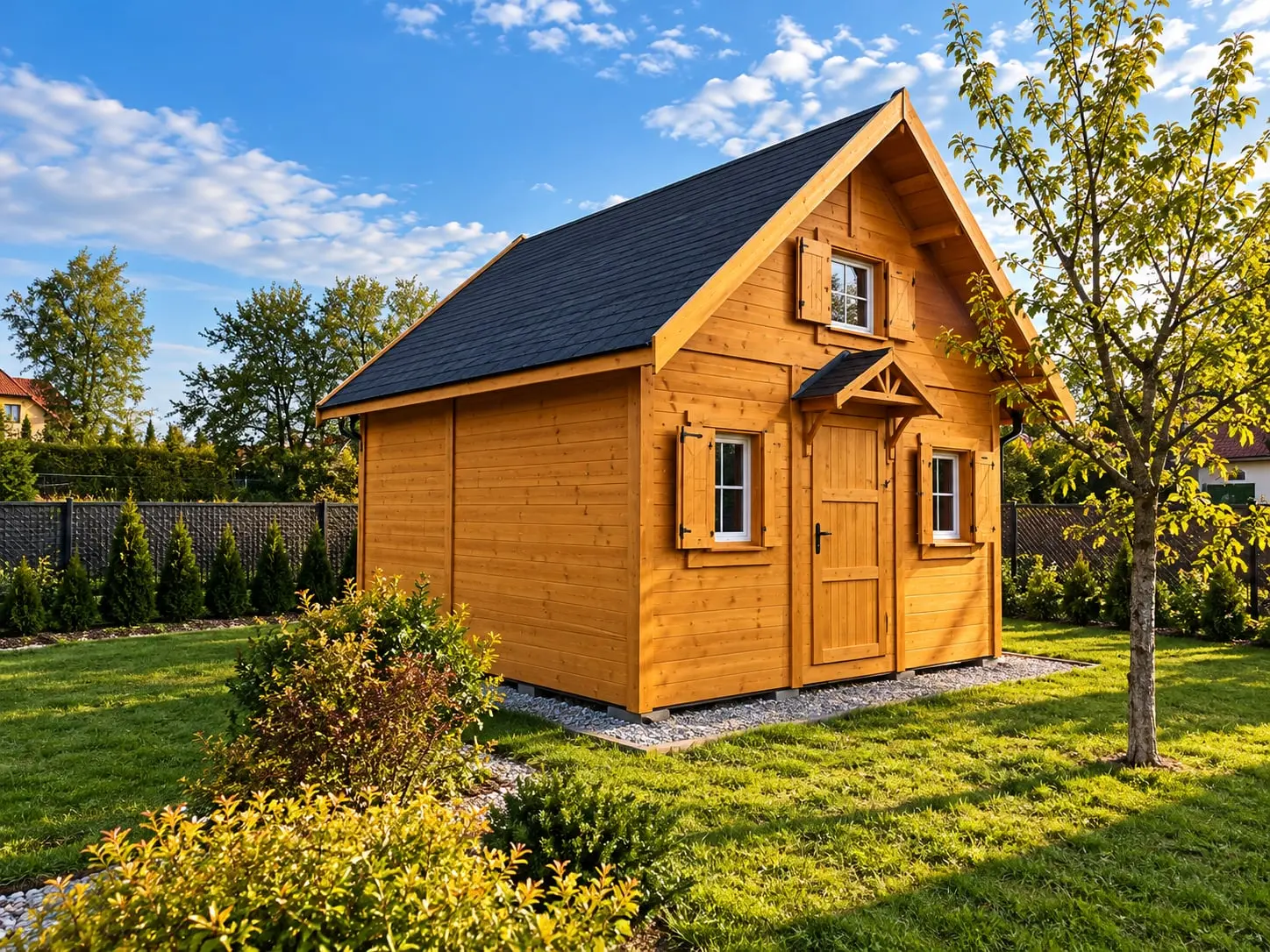
Holiday cabin or all-year cabin – what’s the difference and how much do they cost?
Are you buying a beautiful recreational plot on a green, peaceful site? First, think about the type of cabin you’ll build on it. Do you want one that serves you only in summer, or an all-year cabin? This is a core decision that will determine the functionality of the cabin, but also the cost and the construction time. How do they differ and what do they cost? What formalities must be completed before starting the investment? Read on to learn more!
All-year wooden cottages vs. seasonal ones – definitions, use and legal context
Let's clarify how, in light of law and practice, holiday cabins differ from all-year cabins.
Holiday cabin – for recreational purposes
A holiday cabin is a building intended for seasonal, occasional use, mainly for leisure. It often lacks heating, full thermal insulation or infrastructure adapted to winter conditions (though of course this is possible).
In Polish law it is often classified as an individual recreation building, which means:
a building intended for occasional leisure,
- not a residential building,
- usually single-storey, detached,
- with a built-up area typically not exceeding 35 m².
All-year cabin – an alternative to a traditional house
An all-year cabin, although it may have the same floor area as a holiday cabin (e.g., 35 m²), is designed for year-round living – including winter. It is characterized by:
- good thermal insulation (e.g., mineral wool),
- tight window and door joinery,
- a heating system,
- and full utility provisioning (water, electricity, sewage).
Holiday vs. all-year – legal and functional differences, what to look for?
The biggest difference concerns the purpose of use. If you want to use the cabin only in the holidays – the holiday cabin is more than enough. If you plan to use it year-round, including winter, or want the possibility of legal residence – an all-year cabin is a better choice. You may encounter the expression "holiday-all-year cabin", which is also correct and indicates the intended use of the building.
Note: building an all-year cabin with the aim of permanent residence may require different formalities and meeting additional technical conditions, even if its floor area does not exceed 35 m².
Planning to build a holiday or all-year cabin? Step-by-step formalities
Many holiday cabin owners fear the construction procedures will be complex and time-consuming. In the case of holiday cabins up to 35 m² whether it is a seasonal dwelling or all-year one, that meets certain conditions, you do not need a building permit. This greatly simplifies the process and makes the investment much more accessible.
If your planned recreational cabin:
- has a floor area up to 35 m²,
- is a standalone building,
- is a single-storey (one-storey) building,
- is the only building on a 500 m² plot,
then it is enough to notify its construction to the proper office- at the County Office. Thanks to this solution, construction proceeds smoothly without unnecessary administrative complications – especially if you use Drewnolandia’s ready, proven projects.
What does the notification procedure look like?
The notification process includes:
- Submitting the notification form,
- Attaching a cadastral map,
- Providing a declaration of the right to dispose of the property,
- Adding a sketch or project of the cabin.
After submitting the documents, the authority has 21 days to raise an objection. If no objection is filed – you may proceed with construction.
By contrast, for cabins – both holiday and all-year – with an area over 35 m², the procedure is more demanding. You must obtain a building permit. This requires:
- Submission of a building project prepared by a licensed architect,
- Submitting the project for approval at the County Office,
- Obtaining a decision of building permit – the waiting time is typically 65 days, but it can be longer.
Holiday and all-year wooden cabins – save time and nerves with Drewnolandia
For many clients, the biggest hurdle is the formalities – which is why Drewnolandia offers full support in preparing the documents needed to notify construction. This gives you confidence that everything will be done in accordance with the law.
It’s the ideal solution for those who want to erect a cabin quickly, legally and stress-free. We prepare the complete documentation and help with dealings with authorities. In practice, you only need to choose the project – we take care of the rest.
When visiting the office you need to present a few documents:
- declaration of the right to dispose of the property for construction purposes,
- cadastral map (available at the County Office),
- sketch of the cabin project.
In the notification form (a ready template is available at the office) you must specify the scope of works and their start date.
Holiday and all-year houses – building differences
There aren’t many differences between a holiday cabin and an all-year cabin, but they are fundamental differences. They stem directly from the residential possibilities offered by a recreational building. In an all-year cabin you can live in winter without issues, whereas a holiday cabin is geared toward summer leisure.
Construction of holiday and all-year cabins
Both a holiday cabin and an all-year cabin can be built entirely from wood using a timber-frame technology – Canadian. Is it safe? Absolutely! Modern solutions and construction technologies allow adapting a timber-frame structure to any season and creating comfortable living conditions regardless of the time of year.
Height of holiday and all-year cabins
Both cabins, if built under the notification procedure, can have only one floor. The attic is not counted as an additional floor, where you can arrange, for example, a bedroom. However, in the case of a usable attic, formalities may become more complex.
Foundations for holiday and all-year cabins
An important difference between a holiday cabin and an all-year cabin may be the type of foundations required. For light, small summer cabins, a point foundation of prefab blocks is usually sufficient and can be prepared by yourself. The all-year cabin is somewhat heavier, so a traditional foundation (e.g., reinforced slab) may be necessary. Much depends on the project itself.
Timber for holiday and all-year cabins
Wooden holiday and all-year cabins may differ in the type of wood used for construction, so it’s worth paying attention when buying. At Drewnolandia we use the best available structural wood regardless of whether we’re building an all-year, holiday cabin, or even a garden gazebo. This is C24 structural timber of the highest grade. It is carefully selected – natural defects, too dense knotting or discolorations are unacceptable. It remains robust even under extreme weather.
Moreover we reinforce key structural elements with KVH wood (beam-laminated wood) known for tight joints and good insulation, and with BSH wood of improved mechanical quality that is fully resistant to cracking.
Insulation of holiday and all-year cabins
A holiday cabin used only in the summer does not require additional insulation. The same is not true for an all-year cabin, which must be well insulated and perfectly sealed.
For an all-year cabin, its timber frame is typically filled with mineral wool. This is one of the best insulating materials, which also provides fire protection. An all-year cabin insulated with mineral wool will warm up quickly and lose heat slowly. Besides thermal insulation, mineral wool also provides acoustic insulation, resulting in comfortable living in the cabin.
An all-year cabin must also have tight window and door joinery, to ensure residents’ steady comfort, even on freezing days.
Electrical and plumbing systems in holiday and all-year cabins
In a holiday cabin, the presence of hydraulic or electrical installations is not mandatory. In practice, however, even a short break from electricity and water is uncomfortable. Therefore, most of our cabins, whether used year-round or just in summer, are equipped with essential installations (of course upon the client’s request).
In an all-year cabin another additional installation – heating is needed. When building, it’s worth thinking about a heat source for winter – a modern “koza” stove is enough to heat such a small space; we can prepare it for use during the building’s installation.
Everything depends mainly on individual preferences! If the cabin will really be inhabited only in the summer season, you can opt for a lighter construction without insulation, thermal, or heating solutions. However, the choice should be well thought out – of course a holiday cabin can be converted into an all-year building, but that involves a general renovation with additional costs.
Even if the cabin will be used only on holidays, an all-year cabin in the winter season can be rented out to third parties. This way the whole investment will quickly pay off and, after some time, start generating income.
Holiday and all-year houses – how much do they cost?
Holiday cabins without extra insulation and heating systems will naturally be much cheaper than their all-year counterparts. Much depends on the project, building dimensions, and space arrangement. It can be assumed that the cheapest wooden holiday cabins will start from 30 thousand PLN. In turn the most expensive all-year cabins in our offer exceed 170 thousand PLN. The price range among available options is wide, but in our offer everyone will find a cabin suitable for themselves and their budget.
Frequently Asked Questions
Can you place a holiday cabin on agricultural land?
That depends on soil class and local zoning plan (MPZP). In some cases it will be necessary to convert the agricultural land to building land. Before starting the cabin project, check MPZP provisions or apply for building conditions.
Do wooden cabins require maintenance?
Yes. To ensure the cabin lasts for many years, regularly protect the wood against moisture, UV radiation and fungi – ideally every 2–5 years. Drewnolandia offers cabins already impregnated, which significantly extends their durability.
What heating options are available for all-year cabins?
Besides the popular stoves, cabins can be equipped with:
- electric heaters,
- infrared heating mats,
- air conditioning with heating function,
- pellet stove.
The choice depends on your individual needs and the available utilities on the plot.
Can an all-year cabin be connected to the sewer and water supply?
Yes – if the plot has technical infrastructure. If it lacks it, alternatives are:
- septic tank or a domestic wastewater treatment plant,
- rainwater tank,
- a deep well.
This is especially important if the cabin is larger and intended for living purposes.
How to arrange a small space in a holiday cabin?
Consider focusing on:
- folding or modular furniture,
- an attic mezzanine as a sleeping area,
- built-in ceiling storage,
- large glazing to visually enlarge the space.
Even a small area can be turned into a comfortable relaxation space.
Are Drewnolandia cabins suitable for short-term rental?
Definitely yes – an ideal solution for those investing in tourism. Wooden cabins with full equipment are very popular with tourists in the mountains, at the sea and by lakes across Poland. Their construction provides comfort and coziness year-round.
How long does it take to assemble a wooden cabin?
Depending on the project and scope, assembly takes from 1 to 5 days. Drewnolandia offers fast and comprehensive on-site installation, so you can enjoy a ready cabin almost immediately – without a lengthy construction site.
Can you order a cabin with full interior finishing?
Yes. Drewnolandia can deliver a "turn-key" cabin – with installations, insulation, joinery, and even a ready bathroom and kitchenette. This is a practical solution if you want to move in quickly or start renting promptly.
What conditions must I meet to place a cabin larger than 70 m²?
For cabins over 70 m² you must follow the full building procedure: project, permit, site manager, technical acceptances. Such products are built to order and it’s worth consulting with the company already at the plot selection stage.