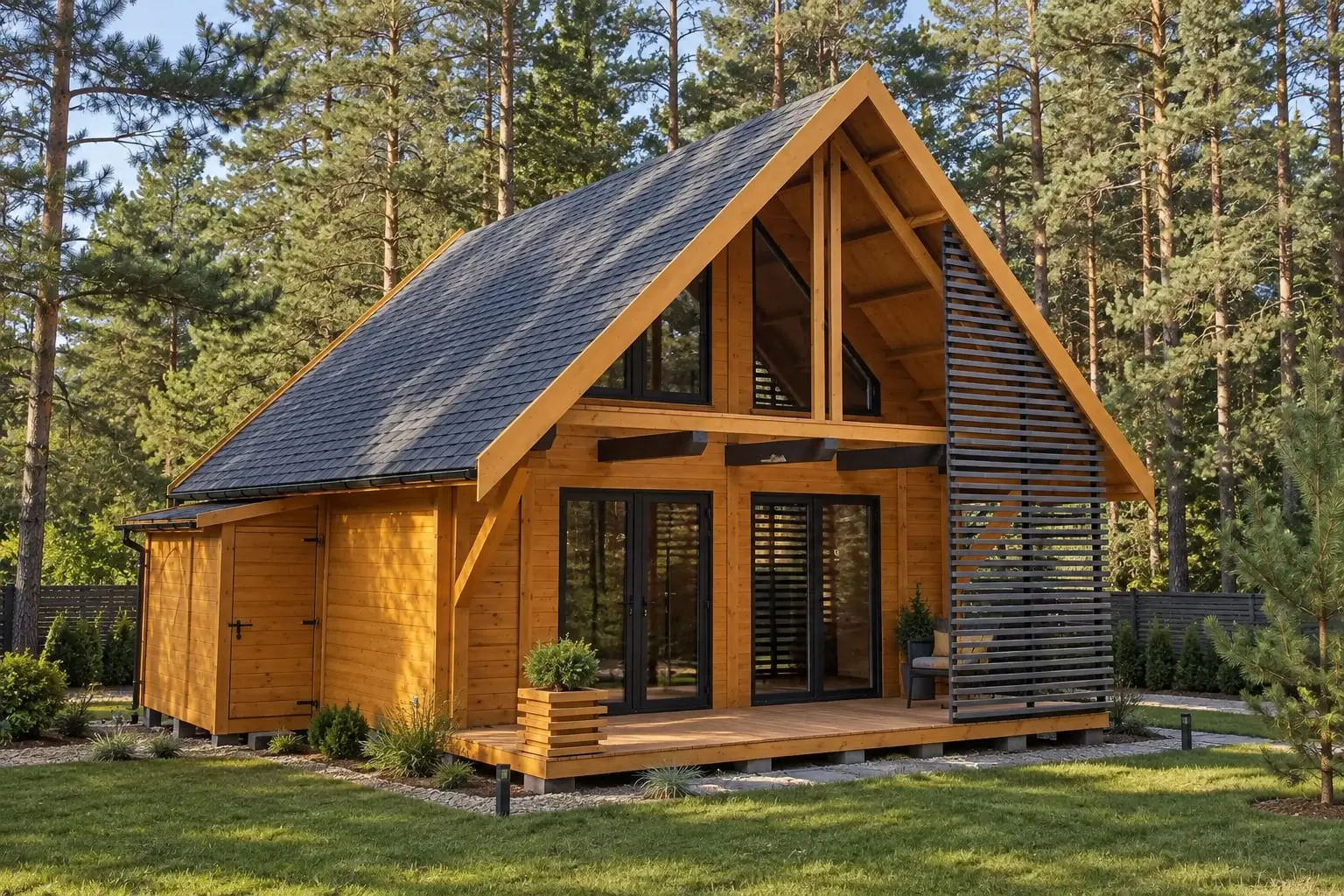
Charming plot awaits, the decision to build a holiday cabin has long been made, even the project has been chosen and… now it’s just about scheduling the start date. Should you wait for spring or summer? Could you start in late autumn or winter? When to begin work so the process runs smoothly and without hurdles? We explain!
On what plot can you place a holiday cabin?
You can place a holiday cabin on a building plot, a recreational plot, and in some cases also on an agricultural plot. On agricultural lands a change of designation may be required, especially if the area is protected for agricultural production or listed in a farmstead development.
What matters is the local zoning plan (MPZP), which indicates whether and what you can build on a given site. If the MPZP has not been adopted, you will need a decision on building conditions (WZ). It’s best to check the details at the municipal office or at the city hall.
What formalities do you need to meet before starting construction?
Formalities related to building a holiday cabin may differ depending on the rules in the given commune. Detailed information can be obtained at the commune office, the county architecture department or at the mayor’s office (in cities with county rights). Before starting the investment, check the regulations contained in the minister of infrastructure’s regulation on technical conditions, which specify among other things the minimum distances from the plot boundary as well as requirements regarding window openings.
To legally start construction, you need to have the right to dispose of the property for building purposes and to submit the appropriate statement of disposition. If there is no local plan, you must obtain a decision on building conditions and issue building conditions. It’s worth remembering that formalities for residential construction and holiday cabins differ – holiday cabins are often built on the basis of a zgłoszenie (notification), whereas residential buildings require a building permit, in accordance with the Building Law.
When choosing a construction technology, it’s worth considering popular solutions such as a wooden cabin or timber-frame construction. Both options are popular due to their speed of execution and aesthetic appeal. Owning your own holiday cabin provides the comfort of carefree rest at any moment of the season.
The construction procedure for a holiday cabin often relies on notification rather than a permit. It’s enough to submit the appropriate application to the architectural-construction authority, describing the planned scope and method of works. Twenty-one days after the construction notification – if there is no objection – you can proceed with the construction works.
In holiday cabins, technical installations that influence meeting the technical conditions are also important. It’s worth noting that a recreational building is usually a single-floor structure, though it may have an attic that is uninhabitable or an attic that is usable (usable attic). Technical rooms, such as the hoist machinery room, are not considered a floor and do not affect the building’s classification.
Choosing a plot for building a holiday cabin
Choosing the right plot is a key step before building a wooden holiday cabin. Before deciding to purchase a particular parcel, make sure it is in an area where recreational development is permissible – based on the local zoning plan or a decision on building conditions. These documents specify, among other things, permissible building area, the building’s location on the plot, and technical conditions.
When selecting a plot for a holiday cabin, pay attention to its location – easy access, attractive surroundings and access to utilities (power, water, sewer) are factors that realistically affect costs and comfort. Also check whether the land lies in an area subject to additional restrictions, e.g. nature protection, flooding or wetlands.
Also remember technical requirements – in accordance with regulations, the usable area of a holiday cabin must not exceed 70 m², and the building should be detached and not connected to another structure. Before starting work, check the required distances from plot boundaries and other requirements resulting from building law.
What is the best season to build a wooden holiday cabin?
We aren’t teaching anyone to suck eggs by stating that the best time to build is warm and sunny months – late spring, summer and early autumn. And this is essentially independent of whether it’s a residential house or a holiday cabin, wooden or brick. This does not mean, however, that when the weather stops being favorable, construction sites must be deserted. A wooden holiday cabin is also a special structure, which – apart from the foundation – basically does not require any
From the perspective of a manufacturer and builder of wooden holiday cabins we can share from many years of experience. In our company Drewnolandii we primarily create small Canadian-style cabins. We prepare the entire structure in our factory (together with proper wood protection) and subsequently – incredibly quickly, in at most a few days – assemble the cabin on the plot and finish it according to the project (insulate, connect installations, etc.).
Always the best season for construction is the warm months, but if the foundation and access to the mounting site have already been prepared beforehand, high temperatures aren’t necessary to complete the work on time.
Can you build in late autumn, winter and early spring?
Of course! The cabins in our offer are made exclusively from wooden elements, and in production and assembly we do not use any materials that require bonding at positive temperatures. A cabin built even in winter maintains its full quality and, in terms of build quality and durability, is no different from those built in summer. There’s also an additional advantage to completing work in this period – you can negotiate a more favorable purchase price.
Everything depends on the foundations of the holiday cabin!
There are, however, some works that should not be carried out in winter. This includes pouring foundations, preparing concrete floors and masonry of walls. For a wooden holiday cabin, the last two are obviously out, but even a small cabin up to 35 m² must be stabilized on a foundation. At Drewnolandia we can only install a Canadian cabin on a foundation prepared by the investor.
Depending on the size and weight of the cabin, usually one of four types of foundations are used.
- Traditional foundation – i.e. standard reinforced strip foundations and a footing placed on them, with filling in the form of sand, reinforcements, concrete and waterproofing.
- Foundation of concrete blocks – rather a shallow pit filled with backfill, and concrete blocks placed according to the house project, then covered with roofing felt and geotextile.
- Foundation slab – excavation filled with sand and reinforcing mesh, then fully poured with concrete and covered with a bitumen membrane or dispersible bitumen.
- Foundations using formwork pipes – pipes driven into the ground (cast in concrete) and attached to them (by anchors or screws) wooden logs/joists.
Foundations of the cabin and traditional materials at temperatures below +5°C
Preparing the foundation using concrete – i.e. in every case except the point foundation with blocks – should be completed before the period when the average daily temperature falls below +5°C. By “completed” we mean full drying and setting of the concrete. Due to the need for digging, the point variant should also be finished before winter arrives.
- When the temperature starts to drop, frosts appear and the ground freezes. It will become very hard, which will hinder site preparation and will cost more and take longer.
- In fresh concrete there is water – if it freezes, the concrete won’t set. Montaż domku letniskowego will be impossible.
- At very low temperatures newly laid walls may crack.
- At temperatures below +5°C all masses and adhesives cure more slowly and take longer, and at extreme temperatures – they freeze, harden and cannot fulfill their functions.
Foundations for a holiday cabin in winter? It’s not impossible!
If the temperature falls below +5°C, you can still execute a solid and stable foundation. You just need winter-resistant building materials, e.g. cement with additives that accelerate concrete curing, or masonry mortars resistant to temperatures down to -10°C. It’s also worth equipping yourself with special heaters to warm at least part of the works and speed up the drying of materials.
Of course, building foundations for a holiday cabin in winter is somewhat risky – even with milder recent winter temperatures they can surprise and drop sharply, especially at night. Therefore it’s best to finish all “wet” works before the first frosts, i.e. early autumn
If the foundation is ready, a Canadian wooden holiday cabin can be mounted regardless of the time of year and temperature. The build may, of course, take a bit longer than in spring or summer.
Resistance of the wooden holiday cabin structure to frost
Why aren’t we afraid to assemble wooden holiday cabins in winter? Because it’s a highly friendly material that doesn’t require “wet” technologies, i.e. mortars, glues, bitumen masses, etc.
The structures of our houses are prepared in advance, including properly impregnated. The cabins’ cladding is joined using the tongue-and-groove method – the tongue of one board fits into the groove of another. This simultaneously ensures tightness and leaves a small space for the wood to freely change its volume with temperature and prevents damage.
In winter we are also able to fully insulate the structure, connect all installations in the holiday cabin and finish its interior. In fact, if our client opts for a well-insulated, heated cabin equipped with a heat source, they can spend the first night there right after installation!
FAQ
When to build a wooden holiday cabin?
If the foundations are ready, wooden holiday cabins can be built regardless of the season, including winter. Simply installing the wooden structure is enough; no more “wet” works are needed. It’s best to finish the foundation before the average daily temperature falls below +5°C.
What formalities must be completed before building a holiday cabin?
If the cabin is not bigger than 35 m², will be a single-story (or with a small mezzanine) and freestanding, and the plot will have only one per 500 m², then the fact of its construction is enough to report to officials. The plot must also meet recreational building conditions according to the local zoning plan.
How much does it cost to build a holiday cabin?
Building a wooden holiday cabin costs from several tens of thousands of PLN and up. Cost depends on, among other things, the building area, materials and formalities. For example, notifying the construction of a holiday cabin (recreational building in line with local zoning plan) is much cheaper than applying for a building permit. The cost is also influenced by the cabin design and how the land is developed.
Can you use a wooden holiday cabin in winter?
Yes – if the holiday cabin is properly insulated, equipped with heating installations and protected against moisture, it can be used in winter. Wooden structures tolerate low temperatures well, especially when they have been properly impregnated and protected during installation.
What foundation should you choose for a holiday cabin?
The choice of foundation depends on soil type, cabin weight and season. Most commonly used are point foundations with concrete blocks, foundation slabs or reinforced concrete footings. When installing in winter, it’s best to prepare the foundation in advance or use a technology resistant to low temperatures.