
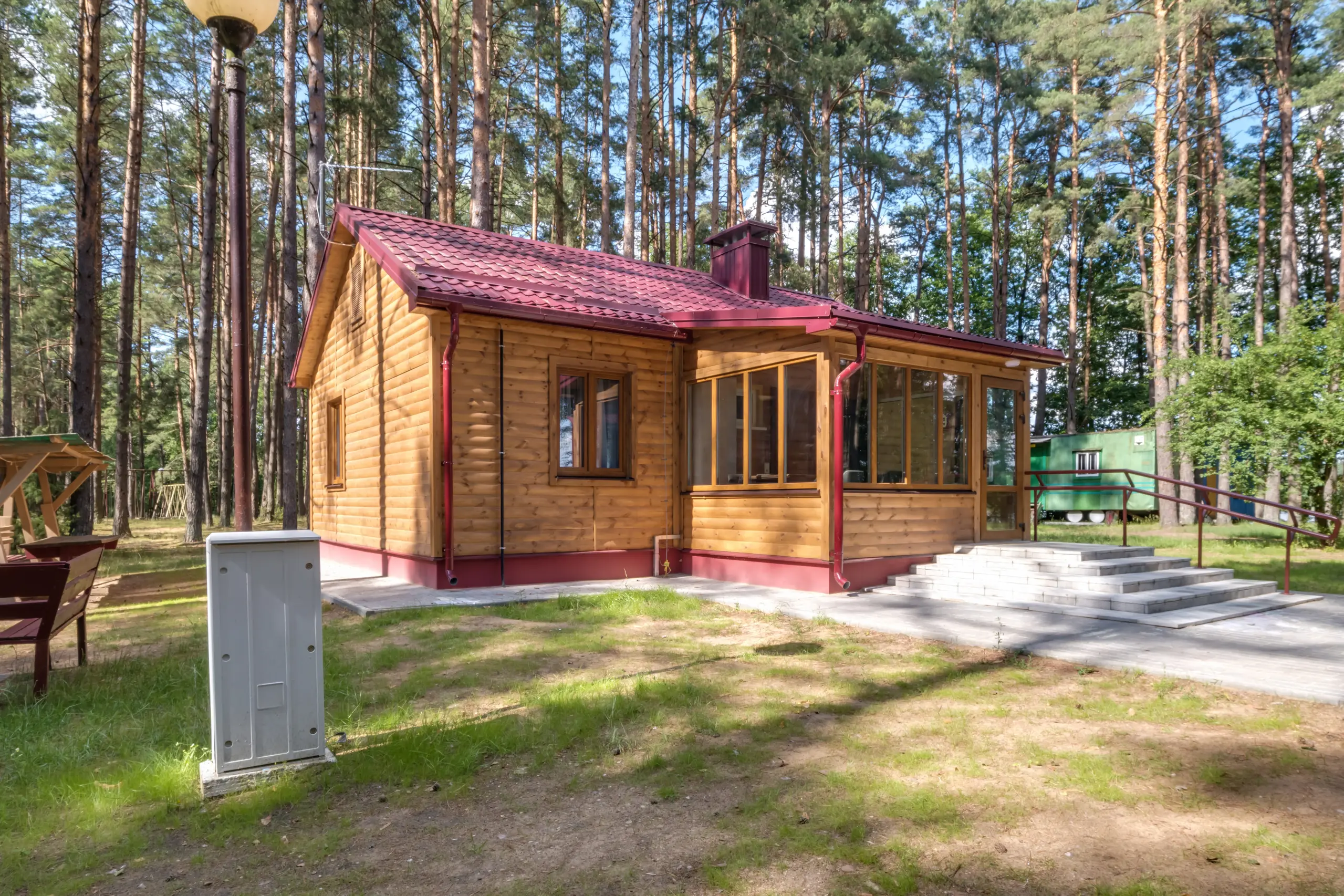
A dream of a private retreat close to nature is often accompanied by a doubt: can a wooden structure, associated with vacation relaxation, become a proper home? The answer is yes — you can live in a holiday cabin all year round, provided it is prepared technically and formally. Although the legal definition of “holiday” implies seasonality, modern wood-house construction technologies enable a thermal standard comparable to traditional masonry buildings.
Living in a holiday cabin and technical aspects
When choosing to live in a holiday cabin, we must first ensure thermal comfort. A standard recreational building typically has thinner walls and basic window joinery, which in freezing temperatures would generate enormous heating costs. For year-round living in a holiday cabin to be economically justified, a proper insulation layer is key.
In Drewnolandia we use systems for insulation based on mineral wool (usually 10–20 cm thick in walls and roof) and vapor barriers and wind barriers. Equally important is replacing windows with triple-glazed packages and installing external doors with a low heat transfer coefficient. Without these elements the structure will cool down in a few hours, and moisture will become a real threat to the wood’s durability.
More about construction differences you’ll learn in our guide: “Holiday cabin or all-year cabin?.”
Formalities: recreation vs. a residential building
Can you live in a holiday cabin all year without changing its status? The Building Law defines such a building as an individual recreation building, intended for periodic rest. Using it continuously for 365 days a year is not prohibited “by default,” but may require changing the way the building is used.
If we want our cabin to formally become a living house, it must meet the Technical Conditions (WT), which are much more restrictive than, for example, garden gazebos. This concerns, among other things, the height of rooms, staircase width, and, above all, energy efficiency parameters. Do you want to learn more on this topic? Read our guide: “Can you convert a holiday cabin into an all-year cabin?.”
Heating and utilities – the foundation of all-year living in a holiday cabin
If you plan a holiday cabin to live in all year round, you must design a heating system matched to the square footage. The most popular solutions are:
Wood stove or fireplace: provide unique atmosphere and quickly heat the wooden interior.
Electric or convection heaters: easy to install, but more expensive to operate (unless you have photovoltaic panels).
Air conditioning with heating function: now one of the most efficient methods.
It is also essential to protect the water-and-sewage installation from freezing. Pipes should run inside the insulation layer or be protected with sheaths and heating cables in sections exposed to ground frost.
Advantages and challenges of living in a wooden cabin
Choosing a wooden cabin as a permanent residence is primarily the speed of realization and lower investment costs. The microclimate inside buildings made of natural materials promotes health and well-being. On the other hand, a smaller area (often chosen are cabins up to 35 m² or 70 m²) requires strong space management discipline.
Recreation home designs from Drewnolandia are planned by our team of architects so that adaptation to all-year use is as simple as possible. By precisely joining elements we eliminate thermal bridges, which is key to success in low temperatures.
Most frequently asked questions about all-year living in a holiday cabin (FAQ)
The topic of year-round use of recreational structures raises many questions, both technical and administrative. Below we have gathered answers to the most common investor doubts to help you make a conscious decision to live in a holiday cabin.
Can you live in a holiday cabin permanently?
Yes, physically it is possible, provided the building has proper thermal insulation and essential utilities (heating, water, electricity). From the formal perspective, to be recognised as residential, the building should undergo the change of use procedure, which requires compliance with local technical conditions.
Can you register residence in a holiday cabin?
Administrative courts in Poland have repeatedly ruled that the address registration is a technical act confirming only the fact of staying at a given address. If you actually live in the cabin, the office is obliged to register you, even if the building is formally a recreational object. Registration, however, does not change the legal status of the building.
Can a holiday cabin up to 35 m² be used in winter?
Yes, provided solid insulation (floors, walls and roof) and a capable heat source. However, note that small volume heats up quickly but also loses temperature faster if heating is not continuous or insulation is weak.
Does an all-year holiday cabin differ from a typical cabin?
The main difference lies in the thickness of insulation and airtightness. An all-year cabin meets standards close to single-family homes (10–20 cm wool insulation, triple-glazed windows), while the typical holiday cabin is often a non-insulated structure intended for use from May to September.
Does living in a holiday cabin affect the property tax?
The tax rate depends on how the building is used and its status in the land and property register. Residential buildings are taxed at a much lower rate than “other” buildings, including holiday cabins. Permanent residence without a formal change of use usually means paying a higher tax rate.