Solar energy is becoming an increasingly popular power source, and this trend extends to small recreational buildings such as holiday cabins. More and more plot owners are choosing photovoltaics for their holiday cabins because they want full or partial energy independence – especially where there is no access to the power grid.
How does a solar panel system work?
A photovoltaic system works by converting solar radiation into electricity. The key role in this process is played by photovoltaic panels, which are made up of modules, and these in turn are built from individual cells. The cells are made of semiconductors, most often silicon. When exposed to light, the cells generate direct current, which an inverter then converts into alternating current that matches the parameters of a household electrical system.
In holiday cabins, a photovoltaic system is particularly valued for its ease of use and the chance to become independent of traditional energy sources. Systems of this type can power basic electrical appliances, lighting, chargers for phones, power banks and small electronics, and can also reduce grid consumption, which translates into savings.
What photovoltaic kit should you choose for a holiday cabin?
Choosing the right photovoltaic kit depends on the building's daily energy needs. The simplest way to calculate power consumption is to multiply the power of all appliances by their daily running time. For example, for lighting and powering appliances in a holiday cabin of up to 35 m², two photovoltaic panels of around 300 W each are enough. The kit should be completed with batteries with a total capacity of around 440 Ah and an inverter with 2000 W continuous and 4000 W peak power.
A charge controller is essential to ensure optimal battery charging and protection against overvoltage. It stabilises the voltage and protects the system from damage caused by overcharging or excessive sunlight.
When choosing a kit, it is also worth considering whether to go for monocrystalline panels, which are more efficient, or polycrystalline ones, which are cheaper. If your energy needs are higher, consider a higher-power kit, which will cope better with powering many devices at the same time.
How do you install a photovoltaic system on a plot?
Assembly of a photovoltaic kit on a plot is relatively simple and often requires no help from a specialist. The kits are factory-prepared as DIY photovoltaic kits and include all the necessary components, such as panels, an inverter, energy storage in the form of batteries, and mounting accessories. You will only need basic tools, such as a screwdriver and a ring spanner.
The installation process includes:
- connecting the charge controller to the battery;
- connecting the solar panels to the controller;
- connecting the inverter to the battery.
Proper installation of photovoltaics also requires following the manufacturer's recommendations on the direction and tilt angle of the solar panels so that they achieve maximum efficiency. In addition, installing such a system lets you become independent of external energy sources and enjoy greater freedom in using your cabin – even where there is no grid access.
For ground installations, concrete foundations are recommended to keep the structure stable. A ready-made mounting system suited to the number of panels and the site conditions is also a good solution – it shortens installation time and extends the life of the whole structure.
The whole process of assembling and configuring a simple kit can be done on your own – depending on the user's experience, it usually takes from a few to a few dozen hours. For more complex systems, it is worth considering help from a specialist to make sure everything works safely and efficiently.
Ready-made photovoltaic kits for plots are available in various power variants and configurations – from simple systems for low energy needs to more advanced solutions that can provide full energy independence for most of the year.
Where is the best place for photovoltaic panels?
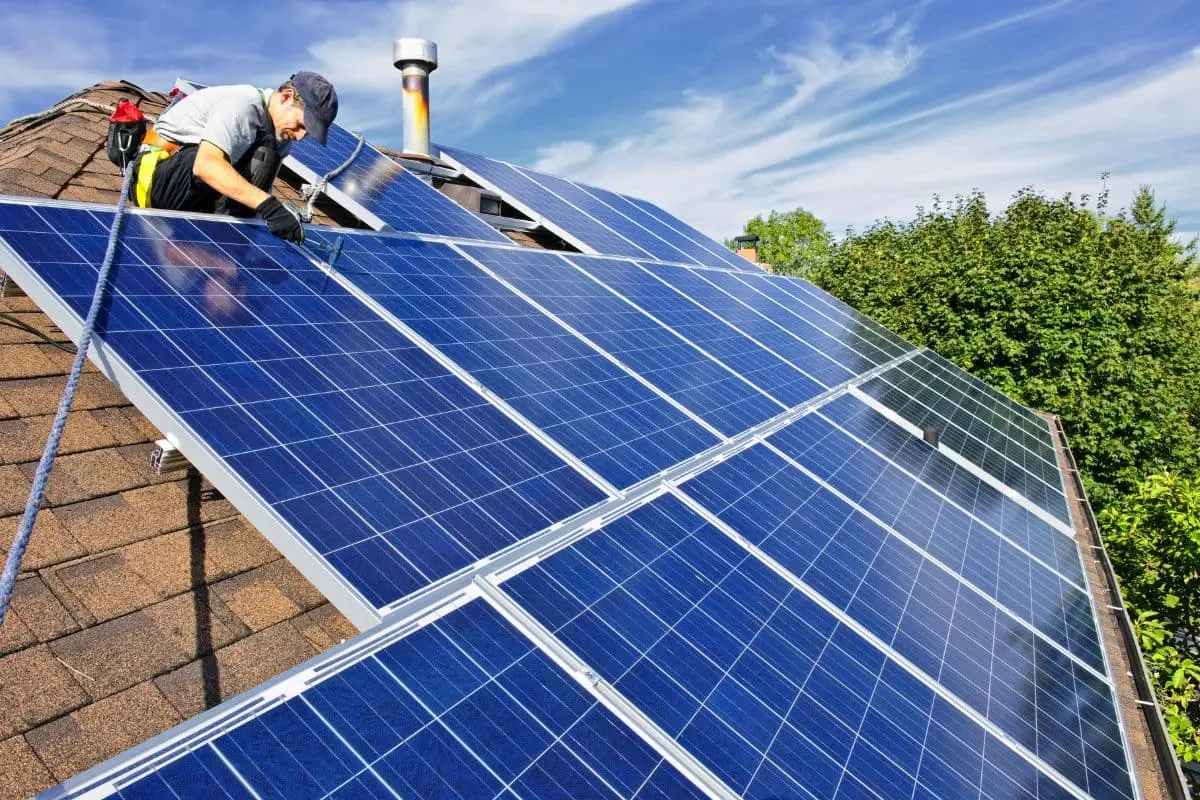
The best place for photovoltaic modules is a well-sunlit area. The panels should face south, with a tilt angle of around 35 degrees. There are various mounting options – the panels can be placed on the roof of the holiday cabin, provided it is not shaded, or on the ground using support structures.
For roof installations, the type of roofing is important. The modules can be mounted on trapezoidal sheet roofs, metal roof tiles, and also on shingles or concrete roof tiles, using suitable brackets. For ground installations, concrete foundations are recommended to keep the structure stable.
Photovoltaics in a holiday cabin – price
The cost of installing solar panels depends on the kit's power and the type of modules used. A basic system for a small holiday cabin can cost from a few to several thousand zlotys, depending on the number of panels, battery capacity and type of inverter.
Keep in mind that the final price is also affected by the quality of the components (e.g. battery durability, panel efficiency, a reputable manufacturer), as well as the level of system automation. Kits made from cheaper components will be less efficient and may need replacing more often. That is why it is a good idea to compare different offers and check manufacturer reviews before buying.
Monocrystalline panels are more expensive than polycrystalline ones, but they are more efficient, which can matter when the mounting area is limited. Additional costs also include buying energy storage devices, which let you store surplus energy for times when panel output is limited. That is why many people choose ready-made photovoltaic kits, which already have suitably matched components and a simplified assembly process.
Is a solar kit enough for the whole year?
Photovoltaic panels work most efficiently in the summer months, from March to October, when sunshine is at its peak. During this period, the systems can power most appliances in holiday cabins, but in winter the system's efficiency drops significantly. Little sunlight and shorter days mean that the energy obtained from the modules may be insufficient.
In the winter months, you should expect to limit the use of appliances or rely on additional power sources. It is also worth remembering that snow covering the modules can stop them from working completely, so it is important to clear the snow from the panels regularly during this period. Even so, a typical photovoltaic kit for a plot works even in the coldest months and can power all-year cabins.
Solar heating for a holiday cabin
What heating should you choose for a holiday cabin? Photovoltaics is one option and can be used to heat holiday cabins, but it requires suitable heating devices. Solar panels can power electric heaters, which are easy to use and energy-efficient. Alternatively, the system can support heat pumps, which are more efficient but require a larger investment.
A roof prepared for photovoltaic panels can also be used to install solar thermal collectors, which heat domestic water and make the cabin more comfortable to use. This solution is particularly useful in all-year cabins, where energy needs are higher.
Advantages of using photovoltaics in recreational cabins
Using renewable energy in holiday cabins brings many benefits, such as:
- independence from traditional power grids;
- lower energy bills;
- the ability to power devices in hard-to-reach locations;
- an eco-friendly solution that is kind to the environment;
- simple installation that you can do yourself.
Is photovoltaics a good choice for a plot?
A solar kit for a plot is an effective way to supply electricity to holiday cabins. Systems of this type are relatively easy to assemble, and using them can bring significant savings. Although photovoltaics will not always work well in winter, from spring to autumn it provides enough energy for everyday use. When considering an investment in panels, it is worth consulting an expert to choose the right kit for your needs.
FAQ
Can a solar kit be connected to an existing power system in the cabin?
A solar kit can be integrated with the cabin's existing electrical system. This requires a suitable inverter and, if necessary, an additional controller that allows the grid and the panels to be used at the same time. Such a configuration enables automatic switching between energy sources depending on demand.
How long does a solar kit work when it is cloudy?
How long a solar kit runs in low sunlight depends on the battery capacity and the power drawn by the appliances. For example, 440 Ah batteries can power basic appliances for several hours even on cloudy days. However, optimal system operation requires occasional recharging in full sun.
Can a photovoltaic system be expanded in the future?
Yes, photovoltaic kits are designed with expansion in mind. You can add extra panels or batteries to increase the system's power. However, you need to make sure that the charge controller and inverter can handle the higher maximum power load to keep the whole system safe.
Does installing photovoltaics on a plot require a permit?
No, in most cases small photovoltaic systems (e.g. up to 50 kW) do not require a building permit. However, if the panels will be mounted on a freestanding structure, it is worth checking with your local office whether any additional regulations apply. On recreational plots and ROD allotments, the requirements may be stricter.
Is photovoltaics on a plot worth it if I only stay there in summer?
Yes, it is an ideal solution if you want to be independent of the power grid or avoid the cost of connecting to electricity. Panels work most efficiently in summer, so even a simple kit will provide energy for lighting, a fridge, a TV or charging devices.
Do the panels need to be maintained or cleaned?
Yes, but not often. Photovoltaic panels are almost maintenance-free, but it is worth removing dust, leaves or bird droppings from them at least once a year. In winter, they should be cleared of snow regularly to ensure maximum efficiency.