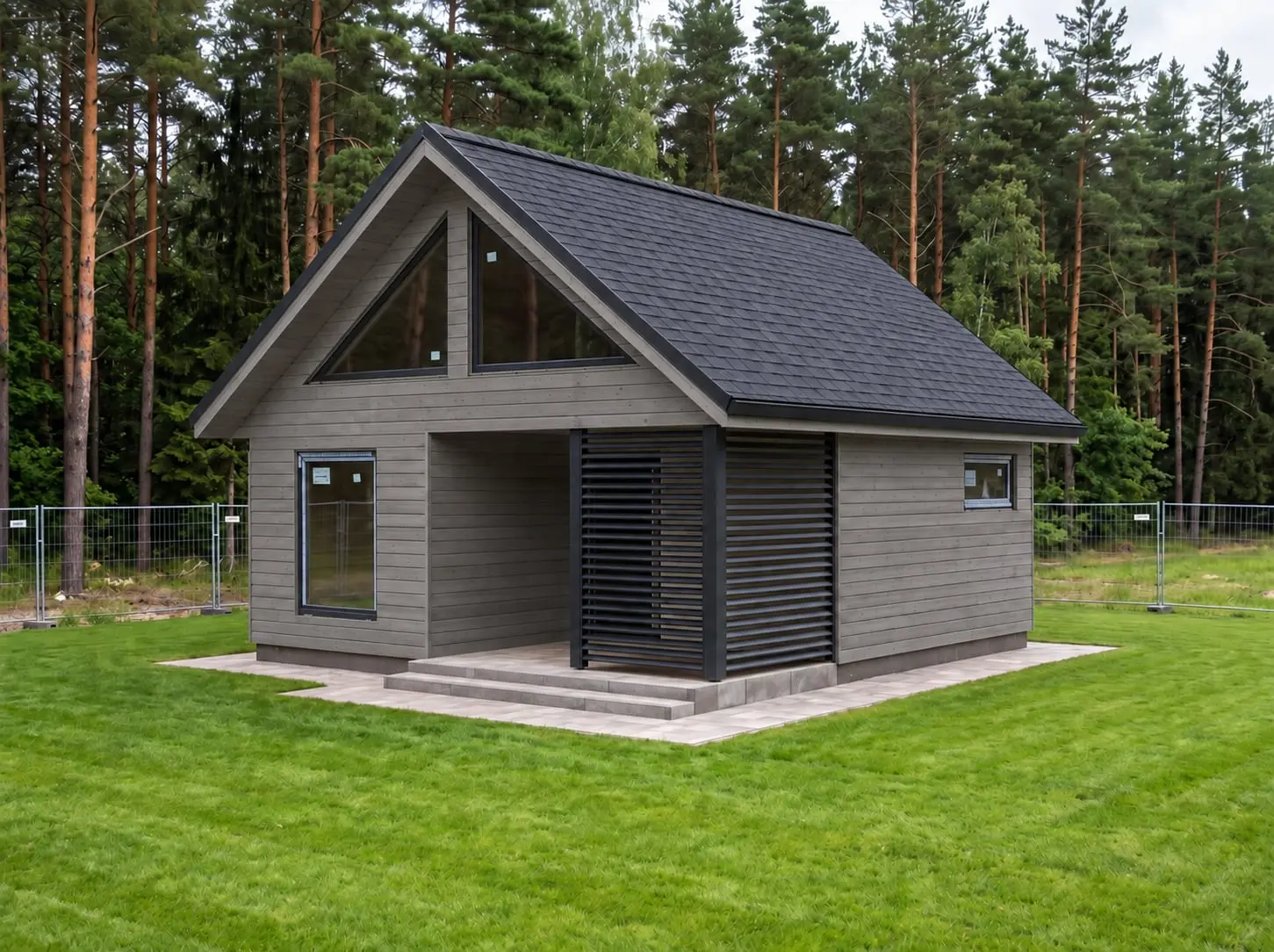
A wooden recreational cabin designed for year-round use is an ideal way to escape the city bustle and stay close to nature, whatever the season. But before you decide to build a holiday cabin, you need to find the right plot. It is the location and the legal status of the land that can determine on which plot a holiday cabin can be built, what formalities await you, and whether the investment will prove comfortable in everyday use. In this article, we'll point out what to look for when choosing a site, which regulations apply in the area of your chosen plot, and what mistakes are most often made at this stage.
Land for an all-year holiday cabin is a key issue. What should guide your choice?
Choosing the right land for building an all-year holiday cabin is a fundamental step that will affect everyday comfort, construction costs, and your future opportunities for seasonal getaways. Is it better to prioritize closeness to nature, or practical conveniences such as infrastructure and access to utilities? It's worth paying attention to aspects such as the distance from home, the surroundings of the plot, the type of ground, and the availability of basic installations that will ensure the comfort and functionality of the building.
Distance from your home. Is a long drive worth it?
One of the first factors worth considering is the distance of the holiday cabin from your place of residence. Ideally, the plot is close enough that you can freely plan weekend trips or quickly get there when needed. In practice, this often means a maximum of 1–2 hours' drive. The greater the distance, the harder it is to make a spontaneous getaway and keep an eye on the property. What's more, under the regulations, one holiday cabin can be built for every 500 m² of plot area – so it's worth choosing a land size that suits your needs.
The cabin's surroundings — far away or deep in the woods?
The surroundings of the plot are not just about aesthetics, but also about relaxation comfort and investment value. Think about whether you dream of mornings by a lake, long walks in the forest, or perhaps winter weekends in the mountains. Areas far from the city bustle are conducive to relaxation, but may have limited access to infrastructure. So it's worth assessing what matters more to you – complete disconnection from civilization or a certain level of comfort.
In addition, it's worth checking whether the chosen site lies within a nature protection zone – in that case, building a cabin may be difficult or completely prohibited. Under the Minister of Infrastructure's regulation, some areas are excluded from development, even if they formally belong to private owners.
Infrastructure and transport access — because you have to get there somehow
Although the idea of a cabin "in the middle of nowhere" sounds tempting, year-round use calls for a somewhat more practical approach. The plot on which you want to build a holiday cabin should have access to a public road – preferably a paved one. In winter, it will be hard to reach the cabin along an unploughed forest track, and the lack of a convenient road can also make it difficult to deliver materials or receive guests.
Availability of utilities is another key aspect. Electricity, water, gas, or a sewage system are often a must if the cabin is to meet the requirements of a year-round building. It's worth checking whether the plot has access to the infrastructure, or what costs and formalities connecting it would involve. The lack of a sewage system usually means you'll need to install a septic tank or a home wastewater treatment plant.
Terrain shape and soil type
Before you decide to buy a plot, take a close look at the terrain. Embankments, depressions, or steeply sloping ground can mean additional ground preparation costs. Flat, stable ground is the best base for construction – both technically and financially.
The type of soil also matters. Plots located on peat or waterlogged ground may require drainage or special foundations, which raises the cost of the investment. That's why it's worth commissioning a geotechnical opinion before signing the contract – it's a small expense that can save you from bigger problems during construction.
Access to utilities — it's good to stay in touch with the world... and have a hot meal
Year-round use of a cabin means providing basic utilities – water, electricity, gas and, more and more often, internet. Before you settle on a particular plot, check whether transmission networks are available in the area. If not, you may need to file connection applications, which lengthens the construction process and increases costs.
It's also worth checking the options for wastewater disposal – if the plot has no access to a sewage system, you must plan to install a septic tank or a home wastewater treatment plant. Some municipalities have additional requirements regarding technical conditions, so consult your local office before making a decision.
Type of plot and its regulations — the law applies to everyone
Not every plot is suitable for building. Under building regulations, to be able to put up a cabin on a plot, you need to check the provisions of the local spatial development plan (MPZP) or – if there is no such plan – obtain a development conditions decision. Sometimes a change in the land's designation will be necessary, e.g. removing it from agricultural use.
Agricultural land, forest land, flood-prone areas, and areas under environmental protection are subject to significant restrictions. Even if a plot looks perfect, it may turn out that building a holiday cabin in a given area requires permits, and sometimes is completely ruled out.
What plot for a holiday cabin – types and development requirements
In Poland, there are several types of plots that can be designated for recreational building: recreational plots, building plots, and agricultural land. Each of these types comes with different development possibilities and formalities.
- Recreational plots are most often chosen for seasonal structures. In some cases, an all-year holiday cabin can be built on them, but only if the plot meets specific technical conditions and lies in an appropriate development zone.
- Building plots offer the widest possibilities – their designation in the MPZP most often allows both single-family and recreational development.
- Agricultural land requires removal from agricultural use – a time-consuming process that is not always possible.
Keep in mind that in some cases a cabin can be built on a plot without a building permit, but it must meet specific conditions: a building footprint of up to 70 m², only one storey, no basement, and an appropriate distance from the plot boundaries. Importantly, only one holiday cabin is allowed for every 500 m² of land.
A building plot and building an all-year cabin
A building plot offers greater development possibilities, including the option of carrying out a project for an all-year holiday cabin. Nevertheless, even if a plot is designated as a building plot, it does not always allow a recreational cabin to be built. Before deciding to build, you should carefully check whether the MPZP or the development conditions for the given plot allow the construction of all-year cabins.
In the case of building plots, the construction process may require obtaining a building permit, which differs from the procedure for building a traditional residential house, especially in terms of requirements for insulation, building footprint, or structure. If the plot does not meet the requirements, it may be necessary to remove it from agricultural use or obtain a change in the land's status.
What plot for an all-year cabin?
A Dutch-style cabin, i.e. a mobile all-year cabin, is an increasingly popular option – especially on recreational plots. Such structures are not permanently attached to the ground, so in many cases they do not require a building permit. But be careful – that doesn't mean they can be placed anywhere you like.
Placing a Dutch-style cabin on ROD allotment plots is prohibited – this is governed by the internal rules of allotment gardens. If, however, you plan to put such a cabin on a private plot, make sure that recreational development is permitted in the local plan and that the land does not require removal from agricultural use. In the case of agricultural land, a change of land designation will be necessary, which can take time and involve additional costs.
What plot for a Dutch-style cabin?
A Dutch-style cabin, also known as a mobile all-year cabin, is a popular solution, especially on recreational plots. Such cabins are often found on land with recreational plot status, but not every recreational plot allows such a structure to be placed on it. For plots located within Family Allotment Gardens (ROD), it is not possible to build a recreational building intended for year-round use.
Another important aspect is checking the MPZP, which specifies whether the plot lies in a zone designated for recreational development, which is crucial when building a Dutch-style cabin. The possibility of obtaining development conditions and ensuring access to the necessary utilities are also important factors. If the plot is located on agricultural land, removal from agricultural use may be required before construction begins, which involves additional costs and formalities.
Building an all-year holiday cabin — what formalities must be met?
Building an all-year holiday cabin without a building permit is possible, provided certain requirements are met. The cabin cannot exceed a building footprint of 70 m² and must be single-storey and freestanding. In addition, it may have only one storey, although a mezzanine is not counted as a storey. A maximum of one such cabin can be built for every 500 m² of plot area.
Before starting construction, you must notify the District Office (Starostwo Powiatowe) of your intention, and construction work can begin 21 days after submitting the notification. The notification does not require hiring a site manager or keeping a construction log, but you must fill in the notification form, attach a sketch showing the building's location on the plot, and submit declarations on the right to dispose of the property and the intended use of the building. You should also make sure that the design complies with the development conditions or the local spatial development plan.
We invite you to explore Drewnolandia's range of all-year cabins built on notification. We'll gladly advise you and clear up any doubts!
FAQ
Can I build a holiday cabin on agricultural land?
Building a holiday cabin on agricultural land is possible only after the plot's status has been changed, i.e. after it has been removed from agricultural use. For agricultural land, certain conditions must be met to be able to develop the plot and put up an individual recreation building, such as a holiday cabin.
Can I build a holiday cabin on a recreational plot?
A holiday cabin can be built on a recreational plot, provided it meets the development conditions and falls within the framework set out in the local spatial development plan. Building a holiday cabin on a recreational plot is permissible, provided it meets the requirements for construction, building footprint, and the intended use of the structure.
Do I need a building permit for an all-year holiday cabin?
Not always. If you want to build one holiday cabin of up to 70 m² building footprint, single-storey, freestanding, and without a basement – you can do it on notification, without needing to obtain a permit. However, this is conditional on compliance with the MPZP or development conditions, keeping appropriate distances from the plot boundaries, and meeting the provisions of the Minister of Infrastructure's regulation on the technical conditions that buildings should satisfy.
If the cabin exceeds these parameters, it requires a building permit and, consequently, also a site manager, a construction log, and final inspections.