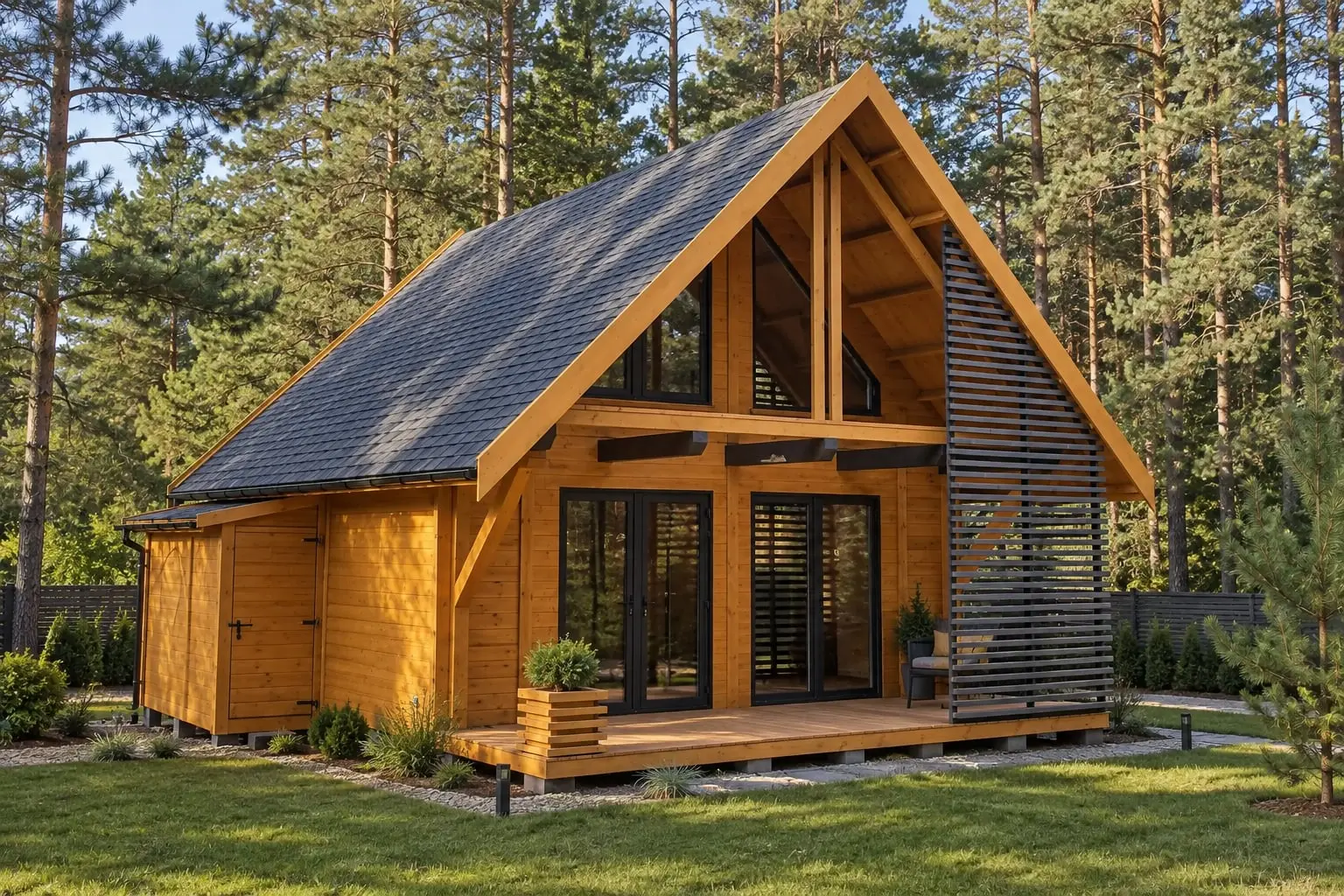
Have you put up a gazebo, a holiday cabin or an extension without a permit? Or perhaps you've bought a property whose legal status raises doubts? Be warned: unauthorised construction is not just a formality – it carries a real risk of fines, a demolition order for the building, and even problems when selling. Find out exactly what unauthorised construction is, how the legalisation of a building works, and when the new regulations let you rest easy.
Unauthorised construction is a topic that has stirred strong feelings for years. In Poland, there are still many abuses involving illegal buildings. Getting a building permit can be time-consuming and complicated, which leads many people to put up structures without the required notifications. Houses of up to 70 m² are growing ever more popular, as under current law, building them does not require a permit under certain conditions.
In 2020, a strong wind tore the roof off a ski rental shop in Bukowina Tatrzańska. The building had been erected without a permit and without proper safeguarding of the structure, which led to tragedy. Such cases are not isolated. In 2018, over 4,000 demolition orders were issued for buildings (1). According to a report by the Supreme Audit Office, building supervision authorities act too slowly and ineffectively, which means the number of potentially dangerous structures may be considerably higher (2). Where do you report unauthorised construction, and how do you deal with it?
What is unauthorised construction?
Unauthorised construction means carrying out building work without the required building permit, without notification, or in breach of an administrative decision. These matters are governed by the Building Law. It most often involves:
- building entirely without documentation,
- starting work before a decision has been obtained,
- significant changes to the design without notification.
Unauthorised construction carries consequences in the form of a financial penalty and a demolition order, as set out precisely in Art. 49b sec. 1: "The building supervision authority orders, subject to sec. 2, by way of a decision, the demolition of a building structure, or part of it, that is under construction or has been built without the required notification or despite an objection raised by the architectural and building administration authority" (3).
Please note that a penalty for unauthorised construction is non-refundable. The exception is when legalisation of the building fails – in that case, the fee paid may be refunded to the investor.
Penalties for unauthorised construction
Unauthorised construction can have serious consequences:
- an obligation to demolish the illegal building,
- a high financial penalty (even reaching tens of thousands of zlotys),
- an entry in the property register noting that the property is subject to proceedings,
- difficulties when selling or renting out the property.
If unauthorised construction is detected, the building supervision authority (e.g. the county building inspector) may initiate proceedings and impose an obligation to halt work immediately.
How to legalise unauthorised construction?
If you own a building that has not been approved for use, you should inform the relevant office as soon as possible. How do you legalise unauthorised construction? To complete the formalities, the investor should submit the following documents (4):
- an application for legalisation of unauthorised construction addressed to the building supervision authority,
- a document confirming that the investment complies with the local spatial development plan,
- a building design and other required attachments, including opinions, approvals and permits,
- a declaration of the right to dispose of the specific property.
The office assesses whether the investment complies with the regulations and, if it finds no irregularities, may approve legalisation once the appropriate fee has been paid.
In some cases, especially with large buildings, the building manager may be asked to provide additional construction documentation and confirmation of compliance with fire safety regulations.Is it possible to avoid the legalisation fee?
In exceptional circumstances, you can apply for the legalisation fee to be waived in whole or in part. The amount of the fee is determined on the basis of the rules for calculating legalisation fees, taking into account the type and size of the building and the degree of non-compliance. The decision on a possible waiver is made by the voivode, who considers the investor's financial and family situation. Free legalisation is a solution applied only rarely, and only after the documentation and justification have been reviewed.
If not all formal requirements are met and the proceedings do not end favourably, there is no need to pay the legalisation fee – but the building will have to be demolished in line with the building supervision authority's decision.
Is there a statute of limitations for unauthorised construction?
No. The current regulations do not provide for a statute of limitations for unauthorised construction. Even if an illegal building has stood for more than a decade, its owner may be called on to legalise or demolish it.
Legalisation after 20 years – changes in the law
Since 1 September 2023, an amendment to the Building Law has been in force that allows simplified legalisation of buildings erected at least 20 years ago, even if they were built without the required notifications or permits.
What do you need to prepare?
- a technical expert report confirming that the building is safe to use,
- a declaration of the date construction was completed,
- surveying documentation.
The simplified procedure aims to put in order the legal situation of thousands of old houses that have operated for years without official legalisation. It can be applied only if construction was completed at least 20 years ago, which must be confirmed by the investor's declaration or by surveying documentation.
An alternative: cabins up to 70 m² without a permit
Want to avoid the risk of unauthorised construction? Consider building a house of up to 70 m², which – under Art. 29 of the Building Law – can be erected without a permit, on the basis of a notification alone. The conditions are:
- a building footprint of up to 70 m²,
- residential or recreational use,
- a single storey,
- construction for your own needs.
All you need to do is submit a notification, with a full set of documents, to the County Office or City Hall. Please note: the notification must be submitted before building work begins.
You can find more information on this topic in the article: Wooden cabins without a building permit – check the current regulations!
Wooden cabins as a convenient solution
Wooden cabins – both holiday cabins and all-year cabins – are popular not only in Poland, but also in Scandinavian countries and Canada. Their advantages include:
- fast completion time,
- a wide variety of available designs,
- the option to extend in the future,
- a natural, attractive look.
Thanks to their lightweight construction and modern technologies, timber-frame cabins can be tailored to the investor's needs. If you care about a quick and hassle-free building process, this is a great option.
Get support from Drewnolandia
Our specialists will be happy to advise you on how to avoid legalisation problems and how to submit a correct building notification. We will also provide the necessary sketches and cross-sections of the timber structure, which will help you get smoothly through the administrative procedure.
FAQ
Can unauthorised construction be legalised if the plot has no local spatial development plan?
Yes, but in that case you will need a decision on development conditions. The building supervision authority will assess whether the investment complies with that decision before allowing the building to be legalised. The absence of a local plan does not rule out legalisation, but it makes the procedure longer.
Can I legalise unauthorised construction if I'm not the owner of the plot?
No, legalisation requires a declaration of the right to dispose of the property for building purposes. Without it, the building supervision authority cannot conduct legalisation proceedings. The owner's consent or an appropriate legal title is essential.
What if the building was constructed in line with technical regulations, but without the required permit decision?
Even if the structure meets the standards, starting building work without the required permit decision is treated as unauthorised construction. In that case, you must go through the legalisation procedure for the building, including submitting the construction documentation.
What actions can the building supervision authority take when life or health is at risk?
Where there is a real risk, the building supervision authority may order the immediate removal of the hazard or the demolition of the building. It does not wait for the standard administrative proceedings to finish. These measures are intended to ensure safety.
Is the investor liable if the unauthorised construction was carried out by the contractor?
Yes. The investor is responsible for the legality of the investment, including starting building work in accordance with the regulations. They should make sure the design complies with the local spatial development plan and that work begins only after the required permit decision has been obtained.
What happens if legalisation does not restore a state of compliance with the law?
In that situation, the building supervision authority issues a demolition decision. The investor must restore a state compliant with the regulations, that is, dismantle the building or part of it. Failing to respond may result in administrative enforcement.
Sources:
1. Legalisation under building law. The amount of legalisation fees and penalties for unauthorised construction, https://sdr.gdos.gov.pl/Documents/OO%C5%9A/Spotkanie%2015-17.04.2019/Legalizacja%20w%20%C5%9Bwietle%20prawa%20budowlanego.pdf
2. Report "Correctness of inspections and effectiveness of enforcement proceedings conducted by building supervision authorities", NIK, 2019, https://www.nik.gov.pl/plik/id,21752,vp,24404.pdf
3. Building Law (Dz. U. 2019 poz. 1186)