Dreaming of privacy in your garden, cool green shade on hot days, or a natural shield against wind and noise? Fast-growing trees are a smart solution for impatient gardeners – they deliver impressive greenery in a short time and can completely transform the character of a space. Choose the right species and you get not just an ornament, but a functional part of your green design. Which trees grow fastest, and what should you know before planting them? Find out before you head to the nursery!
Fast-growing trees that cope well in Polish conditions are especially valuable because they let you create a layered effect, screen off parts of the garden, or introduce a striking specimen tree. They are generally recommended for large and medium-sized gardens, although they can also work in small ones if the spot is well thought out. The question is: which trees grow fastest?
Fast-growing trees introduced into a garden need some care. Older, mature specimens usually manage on their own, but young trees need looking after. As with any other plant, it's best to check their requirements first.
How to care for fast-growing trees?
Although fast-growing trees can deliver a spectacular effect in just a few seasons, that doesn't mean they need no care. Quite the opposite – rapid growth of green mass makes young specimens more prone to drying out, breakage, and nutrient deficiencies. Proper care from the very start is the key to healthy growth and a stable tree structure.
The best planting time is autumn, when the soil is still warm and rainfall is more frequent – this supports root system development. The exception is frost-sensitive species, which are safer to plant in spring, when the risk of frost damage is lower.
After planting, young trees need regular watering, especially during drought. Evergreens also need extra watering in winter, particularly during snowless periods with above-freezing temperatures – this helps them survive without damage. In spring it's worth feeding them with a nitrogen fertiliser, which stimulates vigorous growth, while in summer it's better to use a fertiliser rich in phosphorus and potassium, which will strengthen the plant before winter.
Also remember that, because of their fast growth and frequent planting in open, windy spaces, some trees may need staking – especially in the first years after planting. A stabilised trunk means greater resistance to gales and a lower risk of deformation.
A well-considered choice of location matters too. Fast-growing species can reach considerable size in a short time and become a problem if planted too close to a holiday cabin, terrace, path, or underground utilities. So before you put a spade in the ground – look up and think about the future of this green structure.
Fast-growing deciduous trees for your plot – an overview of species
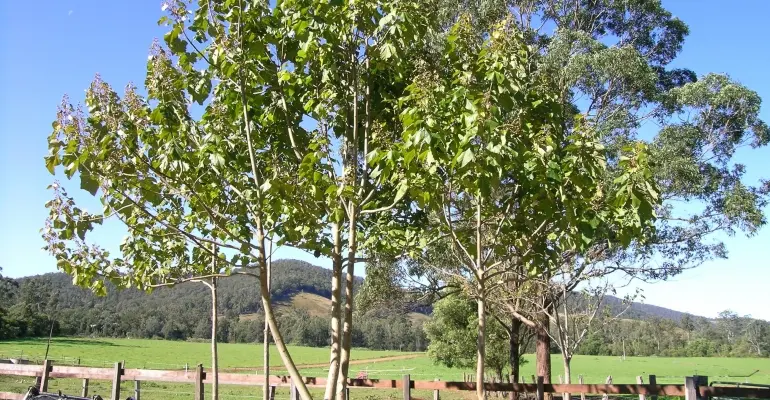
Royal paulownia (Paulownia tomentosa) – the tree reaches about 20 m in height. It is known for its large leaves (15-30 cm) and purple flowers gathered in panicle-like clusters. It blooms in spring, before the leaves develop. Its growth rate when young varies. It can grow several metres a year for a few years, then slows down. It tolerates poor soils. It needs a sunny spot and overwinters well mainly in the warmer regions of Poland.
Tulip tree (Liriodendron tulipifera) – a majestic tree reaching up to 30 m in height in Poland. It produces large, lobed, slightly indented leaves. It blooms in May (the first flowering can be expected after several years of growing). The flowers are creamy yellow and tulip-shaped (hence the name). The fruits are somewhat cone-like. The tulip tree develops best in a sunny position. Its growth rate is 40-80 cm per year. It tolerates air pollution. It is an excellent choice for a prominent specimen tree. The tulip tree is also a valuable honey plant.
Northern red oak (Quercus rubra) – in forests it is regarded as an invasive species, as it grows much faster than native oaks and is strong competition for other species as well. It is an impressive tree reaching 30 m in height. Its greatest ornament is its sharply lobed leaves, which turn spectacular colours in autumn. The acorns are plump, with short stalks. Since 2022 it has been on the list of invasive species in Poland, which may restrict planting it in some areas.
Weeping willow (Salix sepulcralis) – a very fast-growing tree associated with the Polish landscape. It forms a broad crown and usually reaches up to 20 m in height. Growth can be controlled by pruning. It has an eye-catching weeping habit. The leaves are lanceolate and light green, set on slender yellow or yellow-green shoots. They emerge early and fall late, so the willow is ornamental for most of the year. The tree is particularly valued in damp locations and copes well in such conditions. Its wood is very weak and it can be broken by wind.
Staghorn sumac (Rhus typhina) is a small tree/shrub, usually reaching up to 6 m in height. It produces deeply cut, pinnately compound leaves that turn bright red or orange in autumn. At the tips of its shoots it forms cone-shaped red-purple flower clusters. It gives off a distinctive scent. It copes well in difficult locations, even in areas with heavy air pollution. It produces many root suckers, so it is not always welcome in a garden. It is a short-lived species. The sap from the shoots may irritate the skin – take care when tending it.
Fast-growing conifers - an overview of species
European larch (Larix decidua) – one of the fastest-growing conifers; in ideal conditions it grows as much as 100-150 cm a year. Its final height is 40-50 m, so it is best suited to large gardens. It has attractive, delicate needles gathered in tufts. It loses its needles before winter. Small cones densely cover the shoots. They stay on them for several years. Avoid planting it near spruces (because of the risk of spreading pests – spruce gall adelgids).
Dawn redwood (Metasequoia glyptostroboides) – reaches about 30 m in height and has a slender, conical crown. The needles are soft, seasonal, and densely cover the shoots. In autumn they turn yellow and brown, then fall along with the thin, short shoots. The cones are very small and round. Not without reason, the plant is called the "swamp larch". It copes well in damp locations. Young specimens should be protected from frost. The species tolerates air pollution.
So before you decide on a particular tree, check which species grow best in your soil and climate – that way your garden will gain not just a wow effect, but harmony for years to come. Choose wisely and get going – early spring or autumn is the best time to start planting!
FAQ
Can fast-growing trees be pruned?
Yes, in many cases proper pruning is needed from the first years after planting – especially with large annual growth. Regular pruning lets you control the size of the crown and improves the tree's stability. However, you need to know the pruning rules for the particular species so as not to weaken the plant.
Which fast-growing trees are suitable for damp soil?
In damp locations, the best performers include weeping willow, black alder, and dawn redwood. These trees tolerate waterlogged areas well and are resistant to short-term flooding. In such conditions, avoid species susceptible to fungal diseases.
Do some fast-growing tree species have medicinal properties?
Yes, for example willow bark contains natural salicin, which has anti-inflammatory and pain-relieving effects. Linden, although it grows somewhat more slowly, is also known for infusions with sweat-inducing and calming effects. However, before using plants for medicinal purposes, it's worth consulting a herbal medicine practitioner.
Which conifers grow fast but don't reach gigantic size?
Among conifers that grow vigorously but don't become huge trees, arborvitae (thuja) and cypresses are worth mentioning. They reach up to a dozen or so metres in height, are easy to shape, and work great in rows and hedges.
Can you plant fast-growing trees during the flowering period?
It is definitely not recommended. Planting trees during flowering can weaken them, especially when the roots don't have time to settle. The best time is autumn or early spring – that's when plants have time to root calmly.