Operating a home comes with substantial costs. It’s worth looking for savings, and thermal imaging studies are perfect for this. They help quickly identify improper temperature distribution and reveal structural defects such as thermal bridges or leaks. Detecting and eliminating these irregularities allows rational management of the budget. How to do it?
What is thermography in construction all about?
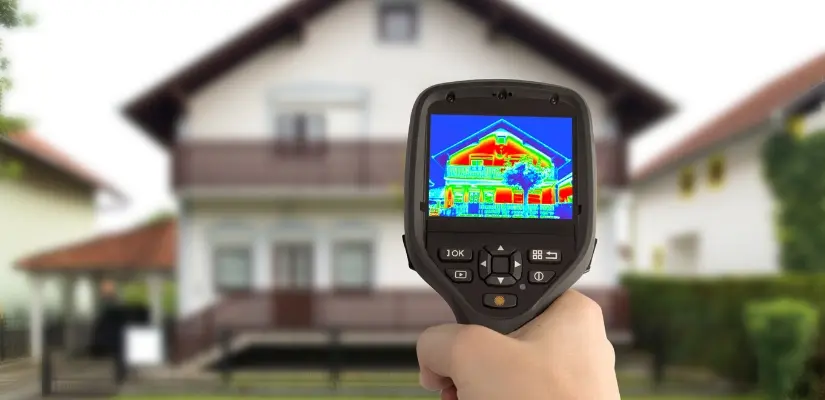
The method involves taking measurements that use infrared radiation invisible to the naked eye. The technique is especially effective in existing buildings, and its main goal is to increase residents’ comfort. For verification of energy losses, dedicated cameras are used that do not affect the structure of the building in any way. Designers, architects, renovation company representatives, and private clients aiming to optimize expenses commonly opt for a thermographic building inspection. Thermographic inspection can be performed both indoors and outdoors (depending on the objective, environmental conditions, and project assumptions).
What do thermographic investigations bring to construction?
Control of heat emission provides information about defects in houses or apartments, such as:
- Thermal bridges
They generate enormous energy losses. They most often appear near balcony corners, around window frames, above lintels, and on ceilings made of reinforced concrete.
- Wet-infiltrated spaces
Thermographic building studies help locate points where moisture accumulates. Over time this can lead to mold on walls and ceilings.
- Hidden defects
The method enables finding various faults, e.g., cracks in wooden ceilings or in plaster. Thus, thermographic investigations in construction provide valuable guidance for investors who want to optimize expenses.
- Damaged installations
Thermography in construction helps locate faults in underfloor heating systems or heating systems (e.g., blocked radiators).
- Thermal anomalies on the roof and facade
The method facilitates identifying uneven temperature distribution. Based on it you can quickly repair or supplement insulation gaps.
- Drafts
Thermography of a home is one of the key ways to check air flow. For this, the Blower Door Method (BDM) is effective. It involves detecting the pressure difference between the interior of the space and the outside environment.
- Fire hazard
Thermal imaging of a home is a tool that helps locate weak points in electrical installations, such as overloaded components or low voltages.
Thermal imaging with a camera – what to remember?
When a thermographic inspection is performed at home, you should:
keep the temperature at least 20 C for a minimum of 12 hours,
close the windows,
switch off heating one hour before the planned measurement,
- move away from the walls furniture, curtains and other elements (12 hours before the analysis begins).
If thermography is planned around the building, the inspection should be carried out when:
- outdoors the temperature is low,
the building’s facade is dry,
the wind speed does not exceed 5 m/s,
the difference between inside and outside temperatures is at least 10 C and this value is maintained for 12 hours.
Thermographic measurements are the future!
Checking the correct distribution of temperatures opens up many possibilities. It is a simple and non-invasive method that helps to find and then eliminate building defects such as thermal bridges and drafts. Sometimes a few small changes are enough to improve the user experience. Thermography measurements are carried out in many places. Popular structures include all-year wooden cabins and holiday cabins. In their case, good insulation reduces operating costs. Drewnolandia is committed to offering objects that do not incur heat loss-related expenses.