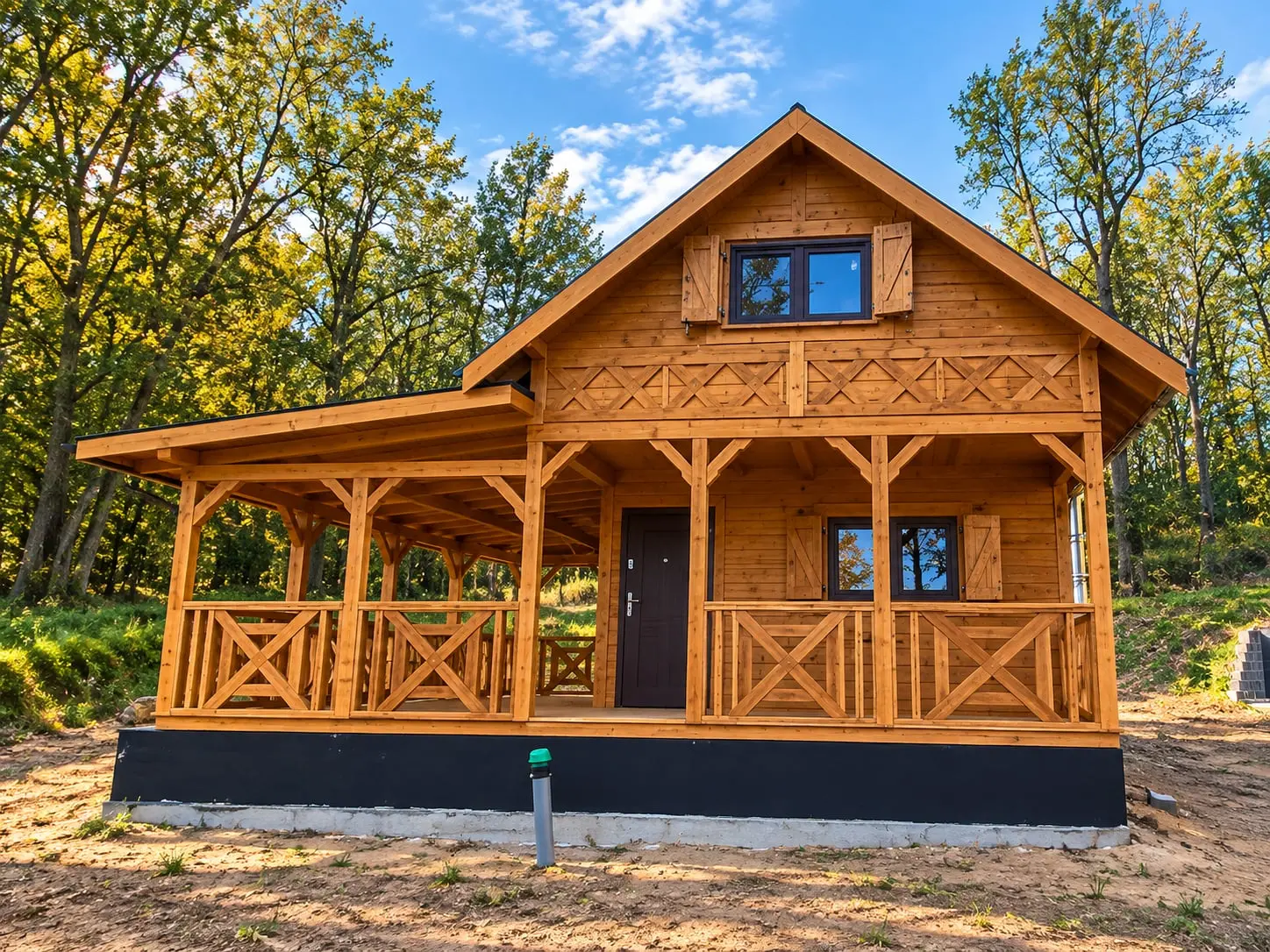
People who want to create their own leisure space away from the city often face two key decisions: where to buy a plot and what to build on it — a wooden holiday cabin or a brick-and-mortar one? Each solution has its pros and cons, so in this article we’ll try to help readers find answers to all important questions about wooden and brick-and-mortar holiday cabins.
Brick-and-mortar holiday cabin or wooden one? Construction types
Both types of cabins can be built in different ways using somewhat different materials. Well-known brick buildings are made from bricks, ceramic blocks, cellular concrete blocks, or other components, joined with masonry mortar. Wooden houses, on the other hand, can be divided into two main categories: log and timber-frame (also called Canadian) . It is this second type of construction that people most often have in mind when asking: what’s the better choice — wooden or brick-and-mortar cabin?
Besides the materials used for their construction, these solutions also differ in appearance. One cannot deny the visual appeal that wooden buildings have, especially in the context holiday cabins. The aim of such an investment is usually to create a private space for relaxation close to nature, away from the city and concrete development. The material that fulfills this condition is wood, a natural resource.
Which is more durable — wooden or brick-and-mortar?
An intuitive answer might point to the brick-and-mortar type, but that isn’t entirely true. Modern technology used in building a holiday cabin in a timber-frame technology is so advanced that these constructions can successfully compete with brick-and-mortar counterparts — both in terms of durability and longevity. A brick-and-m mortar cabin and a wooden holiday cabin can serve many generations, and therefore an investment in it will be lucrative and long-lasting.
Wooden holiday cabins are technologically advanced constructions today, as evidenced by their increasingly frequent use as all-year-round homes. In the Drewnolandia range, this is supported by certified structural wood, which in its properties can replace traditional building materials like steel or concrete.
And what about extreme conditions — such as fire or a gale? Although brick houses have long been associated with durability, modern wooden houses do not lag behind in this regard.With proper wood preservation and modern thermal insulation solutions, both wooden and brick-and-wooden houses are resistant to fire and strong winds. The joining methods used by Drewnolandia — of ceilings, walls and roofs — ensure safe use even in unfavourable weather.
To dispel doubts and choose the optimal project for your plot, it’s worth turning to proven information about both types of constructions. There are still many myths surrounding wooden buildings, which have no basis in reality — a properly designed and built wooden house is today a reliable and durable investment.
Wooden cabin or brick-and-mortar? Choosing a contractor
Advocates of brick-and-mortar holiday cabins often argue that it is much easier to find a proven construction crew specializing in this type of structure. However, today, due to the growing popularity of wooden holiday cabins, this situation is rapidly changing. Thanks to numerous practical and aesthetic advantages, wooden holiday cabins made of wood are gaining recognition among an increasing number of investors, which also improves access to experienced contractors.
In Poland, many companies specialize in erecting various wooden constructions — not only all-year cabins but also light, seasonal recreational solutions. Whether an investor dreams of a wooden holiday cabin with a usable attic, a spacious terrace, or a minimalist single-story form for notification — finding the right contractor is no longer a problem. Modern firms offer comprehensive service — from design to assembly — for both simple recreational structures and more advanced residential solutions.
Wooden or brick-and-mortar recreational cabin? Temperature inside the home
When considering what’s better — wooden or brick-and-mortar — it’s worth paying attention to the indoor temperature and the microclimate formed inside. This is especially important if you plan to use the cabin regularly, not only in summer.
Since this type of cabin serves as a recreational retreat, we usually spend time there in warmer months — enjoying nature, away from city noise, and relaxing outdoors. This doesn’t mean it’s impossible to be comfortable there in winter. With the option to install heating by yourself, a wooden cabin can be used all year round.
One of the main advantages of timber homes is the lack of so-called thermal inertia — meaning that the building heats up very quickly. It takes only a few dozen minutes to reach a comfortable temperature, unlike brick-and-mortar homes. This is a practical solution, especially when we want to arrive for a weekend without pre-preparing the building for use. It’s worth noting that the timber-frame technology used in recreational cabins originates from Canada — a country known for its cold winters, which testifies to its effectiveness and resilience to weather conditions.
Building a brick-and-mortar and wooden holiday cabin
When listing the advantages and disadvantages of the two cabin types, we must not overlook the most important aspect — their construction. It is precisely the construction that often decides the choice of a particular solution — especially when planning a recreational cabin by a lake, in the woods, or another nature-close location.
1. Foundations
Wooden houses have a significant advantage in this regard because they are much lighter than brick-and-mortar ones. This directly affects the foundations – they do not have to be as massive as for brick buildings. For a recreational cabin, concrete blocks, formwork pipes with a wooden frame, or reinforced foundation slabs are sufficient — the choice depends on the investor and the specifics of the plot.
In brick houses, preparing the substrate requires more work — proper reinforcement and pouring of concrete are necessary to support a much heavier structure. This lengthens the construction time.
2. Construction time
In this category, timber constructions again win. Thanks to the use of prefabricated foundation elements, foundations for holiday cabins can be prepared in just a few days. The build itself takes only a few days, and the investor does not need to be on-site — a ready cabin can greet them with a fully prepared interior, ready to use.
Sometimes the plot’s specifics require a sturdier foundation, which may slightly lengthen the project, but even then the process is faster than with brick houses, which require lengthy masonry work and technological breaks.
Another advantage is the ability to install the wooden structure at any time of the year — regardless of temperature and weather conditions — which is not the case for brick buildings, whose technology relies on so-called “wet works.”
3. Work hygiene
When building a brick house, the investor often has to deal with a lot of mess — mortars, paints, dust, plasters, and adhesives require constant cleaning and safeguarding of the surroundings. In wooden houses, the assembly process is much cleaner — the frame is erected quickly and non-invasively, without disturbing the natural surroundings. The owner can calmly come for the handover of the finished object and enjoy a recreational cabin without stress and constant supervision of construction.
Domek drewniany czy murowany? Koszt budowy domu
When it comes to analyzing costs, the answer in the comparison of brick and wooden constructions becomes increasingly clear — a wooden holiday cabin proves to be not only faster but also more economical.
Why? First, building a wooden house in timber-frame technology involves a simplified execution process. Thanks to prefabricated elements and a light structure, the construction time is significantly shortened — foundations can be prepared in one day, and the cabin itself can be erected in the next few days. Therefore, labor costs are also lower because the construction team works much shorter.
Secondly, the materials used for wooden construction are cheaper — both structural wood and insulation, finishing elements, and roofing. Moreover, in most cases a building permit is not required — especially if we plan a cabin up to 35 m² for notification, which further reduces costs and speeds up project start.
Furthermore, wooden houses are characterized by energy efficiency. With appropriate thermal insulation solutions, they heat up quickly, which in the long run translates into lower operating costs — both in the summer and for occasional winter stays.
It’s also worth emphasizing that a wooden holiday cabin is not just a place to sleep — it’s a space conducive to relaxation and active recreation, in harmony with nature. You can spend time there comfortably with family or friends, enjoying freedom from city noise and closeness to nature — without large financial outlays.
Less material cost, shorter construction time, simplified formalities (often no building permit required), and quick availability mean that choosing a wooden holiday cabin is a sensible and cost-effective decision — both financially and practically.
Frequently Asked Questions
Which heating is best for a wooden cabin?
For wooden holiday cabins, compact solutions that do not require central heating are ideal, such as heat-enabled air conditioners, convection electric heaters, infrared heating, or standalone stoves (koza). Thanks to low thermal inertia, heating the interior takes only a dozen minutes. For all-year homes, consider underfloor heating or a heat pump (air-to-air).
What are the location constraints for a wooden cabin on a plot?
A wooden cabin up to 35 m² can be erected only if it does not exceed a specified number of objects per 500 m² of plot. Additionally, it must maintain appropriate distances from plot boundaries, e.g., 3 m for walls with windows or doors. In protected areas (e.g., Natura 2000, flood zones) there may be additional requirements, so it’s wise to check the local zoning plan first.
Can a wooden cabin be easily extended or moved?
Yes — unlike brick houses, timber-frame constructions are more flexible. They can be extended with additional modules, e.g., a terrace, a carport, or a utility room.
How to arrange the interior of a wooden holiday cabin to keep it functional?
The interior of a wooden cabin should be designed with lightness and practicality in mind. Modular furniture, storage under seating, fold-out beds, and mezzanines help maximize space. Natural wood inside doesn’t require painting — just protect it with oil or varnish to highlight its grain.
How to fit a wooden cabin into its surroundings — for example a forest, a lake, or a plot on a slope?
In forested areas, choose a construction with a natural finish that blends well with the surroundings. On uneven plots, point foundations or formwork pipes are used. Near a lake, it is advisable to raise the cabin above ground level and protect materials from moisture. The architecture of the cabin can include panoramic glazing, terraces, or mezzanines with water views.