Do you have a garden and want to make use of plant scraps, cut down on waste, and simultaneously improve your soil fertility? A garden compost bin is the perfect solution – eco-friendly, affordable and surprisingly easy to build. It allows you to transform green waste and kitchen scraps into a natural fertilizer that strengthens your plants and improves soil structure. In this guide you’ll learn how to build a compost bin yourself and how to manage it so it works efficiently throughout the season.
Why have a home compost bin?
Composting is one of the simplest and most eco-friendly ways to manage plant and organic waste that appears in every garden. Through this process you can fully utilize vegetable and fruit scraps, mower clippings or other green waste, turning them into valuable fertilizer. A garden compost bin helps not only to reduce waste but also to enrich the soil naturally, supporting healthy plant growth.
This solution works in both large and small gardens. It doesn't require specialized knowledge – a little commitment is enough to enjoy your own ecological fertilizer and make a real environmental impact.
A compost bin allows you to dispose of troublesome green waste such as mown grass, leaves or plant fragments. It also enables composting of many kitchen scraps and the production of leaf mold soil. Just place it in a suitable spot in the garden and know a few rules to keep it running smoothly and hassle-free.
Where to place a home compost bin?
The compost bin is best placed in a less exposed part of the garden – away from windows, seating areas and gazebos. First of all: it’s a functional rather than decorative structure. Second: decaying organic waste can emit an unpleasant odor, although mature compost should smell like forest litter.
A good spot would be in the utility area, e.g. near a tool shed. Ideally, the station is in partial shade – too much sun can dry the pile and slow down decomposition.
It’s also worth checking local regulations. In some municipalities, reporting ownership of a compost bin can entitle you to some reduction in bio-waste collection fees. You can obtain information about this from your local office.
What to use to build a compost bin?
For building a compost bin you can use:
- wooden boards,
- European pallets,
- plastic modules (buyable),
- garden mesh,
- concrete or brick partitions.
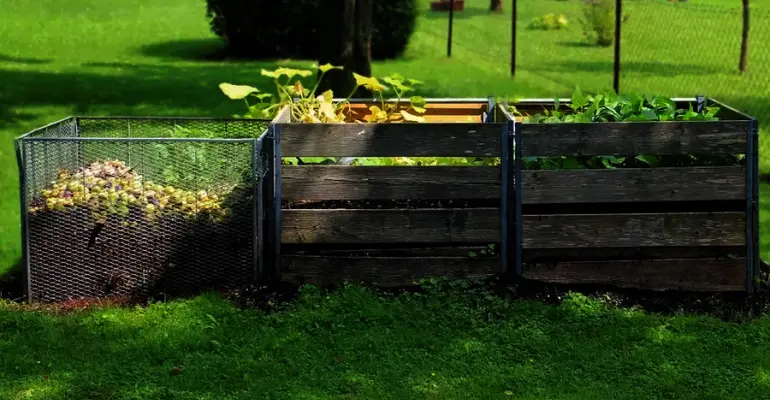
The most commonly chosen are boards and pallets – they are cheap, readily available and easy to work with. You can obtain them from recycling and adapt them to the garden size. A plastic compost bin is a good alternative for small spaces.
If you plan to line the interior with foil, a stapler will help attach it. However, it’s important to remember that the main thing is free airflow – many people skip the foil in favor of mesh or loosely laid boards.
How to build a home compost bin step by step?
Choose a location – shaded, dry, with good access for a wheelbarrow.
Clear the sod and – optionally – dig a pit 30–50 cm deep so the structure sits lower and holds more.
Drive stakes in the corners (e.g. wooden), protect them with stain or wood preservative.
Lay a drainage layer on the bottom from thick branches – it will improve air flow and water drainage.
Attach the sides – boards or mesh with small meshes – on three sides.
Attach the front – ideally a movable one, made from boards laid one over another (without nailing).
Ensure ventilation – ventilation holes and the absence of foil help aeration.
Install the lid – protects the compost from rain and drying out.
Do not exceed a height of 100 cm – it makes stirring and selecting the compost easier.
How does a compost bin work?
A compost bin enables the decomposition of organic matter with the help of beneficial organisms – bacteria, fungi and invertebrates. Thanks to their work plant remnants turn into valuable, crumbly compost rich in minerals. The process requires proper moisture, aeration and a diverse mix of ingredients. Well-managed compost should not emit unpleasant odors.
What can be composted?
You can put into the compost bin:
- vegetable and fruit scraps (peels, skins, trimmings),
- coffee and tea grounds (also with paper filters),
- egg shells (best crushed),
- tree ash (in small quantities),
- mown grass and leaves (best dried),
- small branches and cut plants,
- expired spices (without salt),
- straw and peat,
- hair, feathers,
- shredded cardboard, black-and-white newspapers,
- clean, natural cotton and wool (no synthetics or dyes).
For the process to run properly, nitrogen-rich (green) layers should be alternated with carbon-rich (brown) layers. The optimal ratio is about 2:1.
What should not be composted?
- plant scraps that show disease signs or evidence of pests,
- flowering and fruiting weeds,
- walnut and oak - the former releases substances unfavorable for composting, the latter contains many tannins and decomposes slowly,
- citrus fruits - citrus peels can be composted in small amounts, though they decompose slowly and may acidify the pile,
- meat and bones.
How to manage the compost bin?
To run smoothly, a few key issues must be addressed. First of all, proper moisture of the pile is essential – it must not be too dry or too wet. Dry material won’t decompose, while overly wet material will start to rot and emit an unpleasant smell. Equally important is ensuring regular aeration of the compost, which prevents anaerobic decomposition. To do this, it’s worth mixing the contents of the compost bin from time to time, for example with American pitchforks. A good practice is to layer organic materials – alternating green, nitrogen-rich layers (like freshly mown grass or vegetable scraps) with brown layers that contain more carbon (like twigs, leaves or shredded cardboard). This layering supports even decomposition. Be careful not to create too thick layers of uniform material – especially grass – as they can rot instead of composting.
Typically, the whole composting process takes 8 to 12 months. You can shorten this by using natural speed-up agents such as compost activators available in garden centers, as well as nettle or comfrey tea. Additionally, adding natural fertilizers, such as basalt powder or manure, is recommended. Compost produced faster, for example in 2–3 months, can be used as mulch, but for a full-value fertilizer it’s better to use properly mature compost.
What can you use compost for?
Compost is an extremely versatile product with many uses in the garden. Primarily it serves as a fertilizer for flower beds and vegetable plots, supplying plants with essential nutrients. It can also be used to improve soil structure in vegetable gardens and under lawns, increasing its water and mineral storage capacity.
Compost is also excellent for mulching – you can cover soil around trees, shrubs or perennials, which helps reduce water evaporation and weed growth. It’s also a great base for preparing soil for new plantings – both in the ground and in pots.
Benefits go further – regular composting can significantly reduce the amount of organic waste produced, thereby lowering disposal costs. On larger farms, compost can even be used as a raw material for biogas production. It’s an ecological solution that benefits not only gardeners but also the environment.
Composting is a simple and effective way to convert organic waste into valuable compost that can be successfully used in your garden. In this article we discussed how a compost bin works, the benefits of using compost, and what to watch for during the composting process. If you want to introduce eco-friendly solutions to your garden, consider starting a compost bin – it can be made from wood, pallets or other readily available materials. Remember to ensure free air flow and proper moisture, which will allow the process to run smoothly. As a result you’ll not only reduce waste but also enrich the soil and support healthy plant growth.
Don’t wait for garden and kitchen waste to overflow your bin – turn it into something truly useful. A garden compost bin is an investment that pays back quickly – in healthier plants, better soil and lower waste removal costs. Just a few simple steps to create your own ecological recycling center. Start composting and see how much you can gain – you, your garden and the environment.
FAQ
Can a compost bin be placed in the central part of the garden?
That is not recommended. A home compost bin can emit odors and isn’t very decorative, so it’s better to place it in a less exposed spot than in the central part of the garden.
Which layers of compost are most effective?
The best practice is to layer waste alternately – nitrogen-rich (green) materials and carbon-rich (brown) ones. Such layering supports a uniform decomposition process and helps prevent rotting.
Should a wooden compost bin be impregnated?
Yes, it’s worth protecting a wooden compost bin with an impregnator or stain to extend its life and protect it from moisture. This is especially important for structures exposed to soil contact and water.
What to do if the prepared compost has an unpleasant smell?
That’s a signal the decomposition process isn’t going correctly – the cause may be lack of airflow or too wet interior. In that case, add more dry material (e.g., leaves or shredded cardboard) and mix the contents well.
Is compost suitable for all garden plants?
Yes, well-prepared compost is a valuable organic fertilizer that suits most garden plants. However, avoid using it in large quantities for acidic-loving plants – it’s better to use compost that is rich in conifer or bark material.
What is the best material to make a home compost bin from?
A wooden or pallet-based compost bin is the most popular solution due to material availability and ease of construction. An alternative is ready-made plastic bins, especially in smaller gardens.