
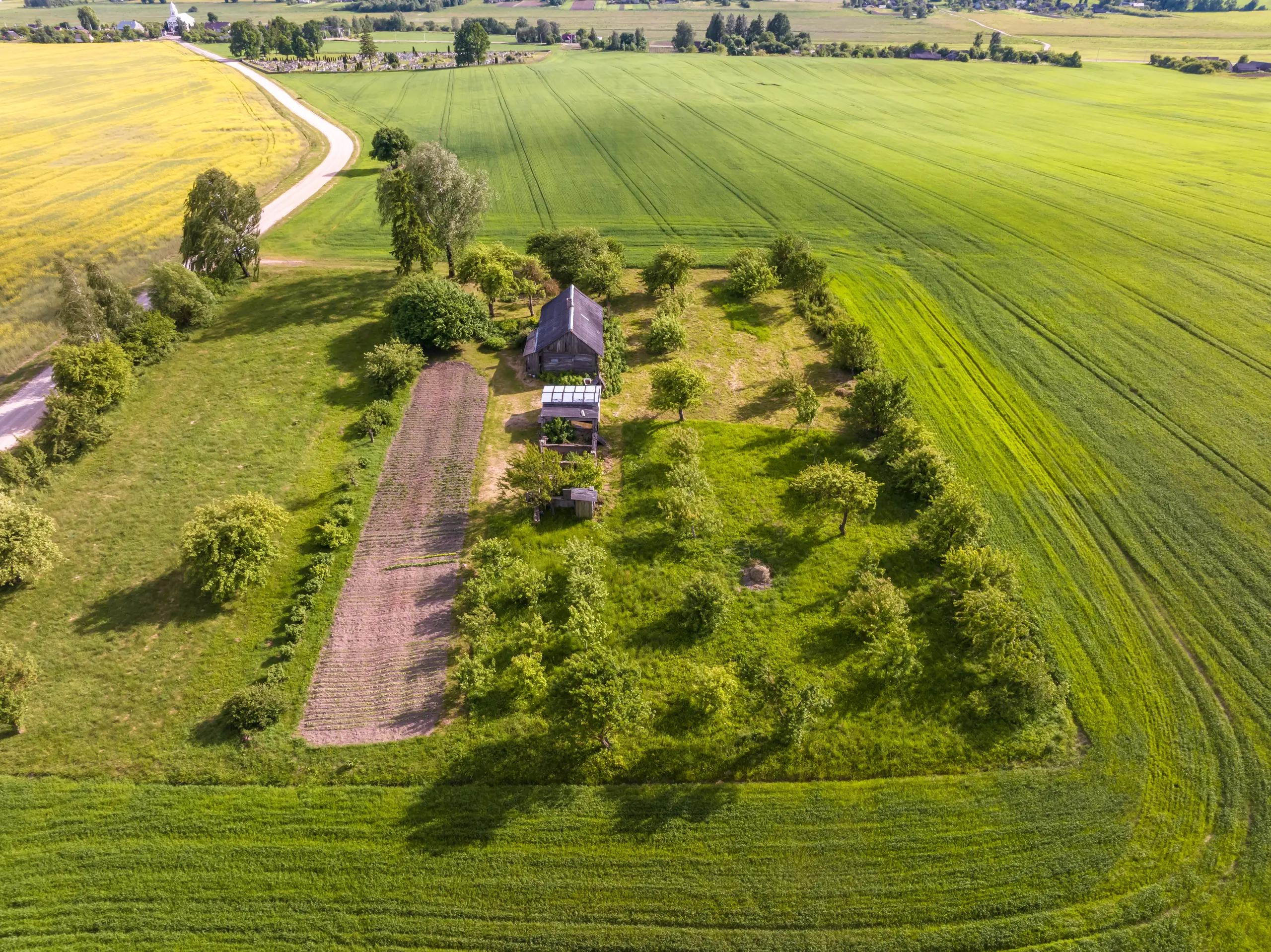
The dream of escaping the noisy city for the countryside, close to nature, very often begins with browsing land listings. That is where many investors first come across the term "siedliskowa plot" (a farmstead plot), tempting them with an unusually attractive price. Unfortunately, a charming farmstead plot is a specific type of land – formally agricultural, but with building permitted only in connection with a farm. Many people therefore make a costly mistake when buying or building, investing in land on which they cannot legally put up their dream home. Find out exactly what a farmstead plot is, what you can build on it and how it differs from a building plot.
What is a farmstead plot – definition and legal basis
If you look for the exact phrase "farmstead plot" in the legislation, you will quickly find that no such category exists there. When analysing the formal types of plots in Poland, the term should be treated as a colloquial expression that comes from official language and real estate practice. To understand what a farmstead plot is and how it is defined, we need to combine the provisions of several different legal acts.
The key act here is the Act of 27 March 2003 on Spatial Planning and Development (consolidated text Dz.U. 2024 item 1130, as amended), which uses the concept of farmstead development. In turn, the Act of 11 April 2003 on Shaping the Agricultural System (consolidated text Dz.U. 2024 item 423, as amended) introduces the definition of an individual farmer and imposes significant restrictions on trading in such land. The law therefore treats a farmstead plot as agricultural land on which – under strictly defined conditions – buildings may be erected.
On this basis, a farmstead can be defined as follows:
A farmstead plot is a separate part of agricultural land on which a agricultural homestead may be located – that is, a residential building and outbuildings closely tied to running a farm. For this reason, the land is not a standalone building plot. It retains the status of agricultural land the whole time, which means that the possibility of building on it is a privilege arising from farming activity.
Farmstead plot vs building plot – what is the difference?
The differences between a building plot and a farmstead plot are fundamental and determine who can own them, on what terms, and what can be built on them.
These differences are illustrated in the comparison table below:
The difference between these types of land is so great that a mistake when buying can be extremely costly. Buying a farmstead plot with a quick house build in mind by someone who is not a farmer most often ends in a years-long battle with the authorities.
How to check whether a plot is a farmstead or a building plot?
Before taking any financial steps, you should thoroughly verify the status of the property in three steps:
Check the MPZP: look at the local spatial development plan at the municipal office or on the geoportal.gov.pl portal. Look for the graphic and letter designation: the RM symbol means farmstead development, while MN means single-family residential development.
Analyse the WZ decision: if the municipality has no plan, the development conditions decision will be crucial. You must check whether it concerns residential or farmstead construction.
Extract from the land register: review the land-use classifications in the document from the county office. Classes marked R, Ps or Ł confirm agricultural status. The B symbol denotes residential land.
What can be built on a farmstead plot?
The answer to this question is closely tied to the profile of the farming activity. Building law allows here only structures that make up a so-called pure agricultural farmstead. An investor who meets the conditions can put up:
A single-family residential building (serving the housing needs of the farmer).
Outbuildings and livestock buildings (barns, cowsheds, chicken coops, storehouses, silos).
A garage for farm machinery and private cars.
Other technical infrastructure directly related to the farm.
The key restriction is that the development must be closely tied to running a farm. The law completely rules out buildings of a commercial, office or multi-family nature. It is worth knowing that development parameters, such as the intensity index, height or biologically active area, are set in advance by municipal planning documents. If you dream of living close to nature, the great news is that residential buildings in farmstead development can be built with a timber structure. An eco-friendly, all-year timber house is a popular and fully permissible form of construction in rural areas.
Can you build a single-family house on a farmstead plot?
Yes, building a single-family house on such land is entirely possible, but only if you have the status of an individual farmer or if the relevant designation in the MPZP allows it (symbol RM) permitting investments for third parties, which happens rarely.
Under Article 6 of the Act on Shaping the Agricultural System, to have the status of an individual farmer you must own or lease agricultural land with a total area of at least 1 ha, have documented agricultural qualifications, and have lived in the given municipality for at least 5 years while running the farm personally. Without meeting these formal criteria, a building permit for a timber or brick house as a farmstead will be rejected by the officials.
Can you put a holiday cabin or recreational house on a farmstead plot?
The short and unambiguous answer is: NO. Farmstead development must by definition be an integral part of an agricultural holding. A recreational house or holiday cabin does not meet this statutory condition.
Some investors try to get around these rules by building holiday structures under the guise of outbuildings or tool sheds. However, you should know that such action exposes the owner to serious legal consequences. The building supervision authority has the right to inspect the structure and, if it finds a change of use made without notification or an unauthorised construction, issue a decision imposing a huge legalisation fine or a demolition order.
If your only goal is relaxation, a much safer solution is a typical recreational plot, where putting up holiday cabins is fully legal and simplified. But before you sign a contract with the land seller, it is worth reading the guide on how to choose a plot for a holiday cabin, so that the whole investment process goes stress-free.
Who can buy a farmstead plot?
Restrictions on trading in agricultural land under the Act on Shaping the Agricultural System mean that buying a farmstead is not available to everyone. As a rule, the buyer of agricultural land larger than 0.3 ha (3000 m²) must be an individual farmer. However, the Act provides for certain important exceptions. Without farmer status, you can buy a farmstead plot when:
The total area of the plot is less than 0.3 ha.
The acquisition takes place through inheritance or a vindication legacy.
The buyer is a person close to the seller (e.g. descendants, ascendants, siblings).
The plot has an area of up to 1 ha, but in this case the National Support Centre for Agriculture (KOWR) retains the right of pre-emption.
Buying a farmstead plot by an "ordinary" citizen who is not a farmer is therefore possible in certain cases, but a transaction above 30 ares requires a conditional agreement in notarial form and waiting for KOWR's decision. You will encounter similarly restrictive rules on purchase and development if you become interested in a forest plot, which is governed by its own strict nature protection laws.
Can a farmstead plot be converted into a building plot?
Many investors are tempted by the idea of buying a cheap farmstead and converting it later. It should be stressed, however, that the phrase "converting a farmstead plot into a building plot" is purely colloquial. In reality, the process involves complicated, multi-stage legal and administrative procedures:
Change of designation in the MPZP: this requires submitting an application to the municipal office to change the provisions of the local plan from RM to MN. However, this procedure depends entirely on the will of the municipal council, is very costly for the local authority and often takes from several to over a dozen years.
Obtaining a WZ decision for a person who is not a farmer: where there is no MPZP, you can apply for development conditions for a classic single-family house. This is possible if the plot meets conditions including access to a public road and the so-called good neighbourhood rule (the neighbouring plot must be built up in a similar way).
Removing land from agricultural use: after obtaining a WZ decision or a change in the MPZP, you must submit an application to the county office to remove the land from agricultural production. For poorer soil classes (IV, V, VI) this is a formality, while for fertile classes (I, II, III) it requires the ministry's consent and is sometimes impossible.
Fully converting agricultural land into building land is therefore a difficult, lengthy process with a high risk of refusal.
How much does it cost to convert a farmstead plot into a building plot?
The costs of the procedure for removing land from agricultural use and converting it are not fixed. They may include a planning fee (the municipality may charge up to 30% of the increase in the property's value after the MPZP change if you sell it within 5 years), administrative and surveying fees, and any charges for removing land from agricultural production (for higher soil classes, the fees can reach over a dozen thousand zlotys).
Because the cost is highly individual and depends on the specifics of the municipality and the plot itself, it is definitely worth being cautious before taking action and consulting a surveyor or a lawyer specialising in real estate law.
Frequently asked questions about farmstead plots (FAQ)
The subject of agricultural and building land raises many questions, so below we have gathered answers to the most common ones.
What is a farmstead plot?
It is the colloquial name for a part of agricultural land on which the regulations permit farmstead development, that is, a residential house and outbuildings used to run an agricultural holding.
How does a farmstead plot differ from a building plot?
A farmstead plot formally remains agricultural land with restrictions on development and trading, whereas a building plot is typically residential in nature and can be bought and built on by anyone without obstacles.
Can a person who is not a farmer buy a farmstead plot?
Yes, if the plot area does not exceed 0.3 ha. For plots of 0.3 to 1 ha, purchase by a non-farmer is possible, but KOWR then has a statutory right of pre-emption.
What can be built on a farmstead plot?
Legally, you can only build a residential house for the farmer and outbuildings and livestock buildings closely tied to running and servicing the farming activity.
Can you live on a farmstead plot all year round?
Yes. A house legally built as part of farmstead development is an all-year building and meets the same technical and housing standards as a classic single-family house.
How to check the designation of a plot before buying?
You should verify the provisions of the Local Spatial Development Plan (MPZP) at the municipal office (or on Geoportal), apply for development conditions, or obtain an extract from the land register at the county office.