

A holiday cabin is a dream for many people who want a place of their own to relax. Thanks to changes in building regulations, putting up a recreational cabin of up to 35 m² has become easier than ever! Such a building is classed as a notification-only cabin – no building permit is needed, provided, of course, that certain requirements are met.
In this article, we explain when a notification is enough and when a building permit is still required. You will also learn which documents you need to prepare, how long the procedure takes, and what mistakes investors most often make when planning a notification-only holiday cabin. If you are planning to build your own place to unwind, this guide is for you.
Why are notification-only cabins becoming more popular?
More and more people are giving up holiday hotel stays in favor of their own all-year or seasonal retreat in a favorite location. A notification-only cabin lets you spend time in comfort – on your own terms, with no fixed check-in times, no bans on pets, and no need to book months in advance.
Changes in building regulations mean that putting up a small recreational cabin no longer requires a building permit – all you need is a notification to the relevant County Office (Starostwo Powiatowe). This is why structures of up to 35 m², formally known as individual recreational buildings, are becoming ever more popular.
Before you start building, however, you must make sure your project meets certain conditions. You also need to prepare the necessary documents and submit a complete notification – only then can you legally begin work.
Building a holiday cabin – notification or permit?
When planning a holiday cabin, the first thing to determine is whether a construction notification is enough or a building permit is required. The differences between the two procedures are significant – both in terms of formalities and the waiting time before work can begin.
A house without a permit – what is a construction notification?
A construction notification is a simplified procedure that allows small projects to go ahead without obtaining a formal administrative decision in the form of a permit. This applies, among others, to individual recreational buildings, i.e. those used for occasional leisure stays.
To use this procedure, the project must meet certain conditions:
- the building's footprint must not exceed 35 m²,
- only one such structure is allowed per 500 m² of plot,
- the building must be detached and single-storey (a mezzanine is allowed, but not a habitable attic or a full additional floor),
The notification must be accompanied by among others:
- a site development plan showing the layout of buildings and access roads,
- a sketch or an architectural and construction design of the cabin,
- a statement of the right to use the property for construction purposes,
- an extract from the land register and a site map (available from the county office or city office).
If the authority (usually the county office or the county building supervision inspectorate) raises no objection within 21 days, construction work can begin. This lack of response is known as tacit consent.
Please note! Since 2022, it has also been possible to build single-family houses with a footprint of up to 70 m² on the basis of a notification – without a building permit and without a site manager, but only for your own housing needs and subject to additional conditions (e.g. detached building, maximum 2 storeys, a building design). However, this option applies only to residential houses, not to holiday cabins.
What is a building permit and when do you need one?
A building permit is a full administrative procedure, required for larger or more complex projects. It is necessary, among other cases, when:
- the building footprint exceeds 35 m²,
- several structures are planned on the plot (more than one cabin per 500 m²),
- the cabin does not meet the structural requirements for notification-only structures (e.g. it has two storeys or is not detached),
- the project is located in an area covered by a special local spatial development plan that provides for different building conditions.
In this case, a site manager, a full building design, and a construction logbook are required. It will often also be necessary to obtain a development conditions decision if the area is not covered by a local development plan (MPZP).
A building permit can mean a longer process, but it gives greater legal certainty – the decision is formal confirmation that the project has been assessed against building regulations, location, and compliance with land development plans.

Bolesław Cabin - 7x5m (SSZ)
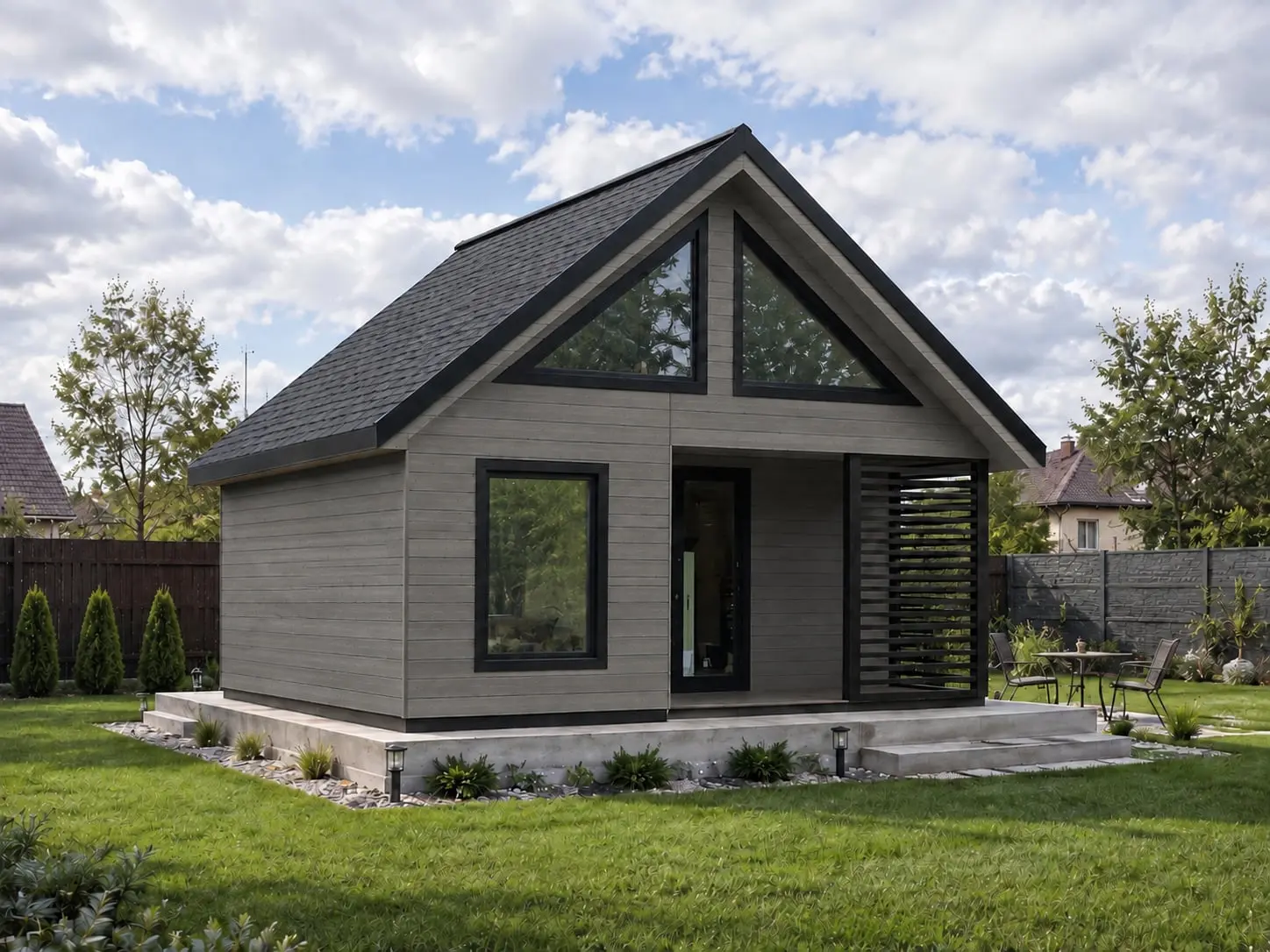
Wiktor IV v2 Cabin – 35 m² (SSZ)

Cyprian Cabin - 50 m2 (SSZ)
Notification or building permit for a house – the most common mistakes and how to avoid them
Although the notification procedure for a holiday cabin seems simple, many investors make mistakes that can lead to delays, extra costs and, in extreme cases, the demolition of the structure. Find out what to pay particular attention to – before you submit your documents.
Checking development conditions too superficially
Many investors assume that because a cabin is under 35 m², they can put it up anywhere. However, local regulations – the local spatial development plan or a development conditions decision – may rule out recreational buildings altogether or impose specific building parameters (e.g. height, roof pitch, distance from plot boundaries).
That is why you should check the MPZP on the geoportal or apply for development conditions. If you are not sure, consult your local office or a specialist. You can also ask the Drewnolandia advisors for help – we are always happy to advise and support you.
Submitting a notification without carefully checking the plot boundaries
A cabin may meet all the formal criteria, but if it is built too close to the plot boundary, the authority may challenge the project. This applies in particular to narrow or irregular plots, where it is difficult to maintain the minimum distances.
That is why it is best to commission a land survey to mark out the site before submitting the notification. It is a small cost that can save you from a serious problem.
Failing to meet obligations after work has started
For projects requiring a permit, many investors forget about formalities such as:
- keeping a construction logbook,
- appointing a site manager,
- notifying the county building supervision inspectorate that work is starting.
Failing to do so can result in work being halted, an inspection, or an administrative penalty.
Before you break ground, check whether your project requires these elements – especially if you are building a structure larger than 35 m².
Wrongly assuming that a design is not needed
Some investors try to submit a construction notification without any sketch or with a hand-drawn one. However, offices increasingly require an architectural and construction design, even for notification-only cabins – especially in tourist municipalities, where detailed urban planning guidelines apply.
How to avoid this mistake? Order a ready-made design adapted to local requirements – for example from Drewnolandia, where cabins are designed in line with the applicable standards.
Starting construction too early
Although the notification procedure is based on so-called tacit consent, some people start construction work immediately after submitting their documents. If the office raises an objection within 21 days, the investor will have to stop work – which can mean financial losses and legal complications.
Be cautious and wait the full 21 days. Also make sure the documentation has been properly accepted by the office.
Why is it worth having your own holiday cabin?
Owning a holiday cabin is not only a way to relax in comfort, but also a sensible investment decision. More and more people are choosing a cabin that can be put up quickly and legally – in line with current building law.
A small individual recreational building means:
- convenience – you always have your own place to relax, with no bookings and no restrictions such as hotel rules or a ban on staying with a pet;
- savings – no more yearly costs of renting holiday accommodation or cabins at resorts;
- independence – you spend your vacation on your own terms, can host a family gathering or a party with friends, or simply escape the daily hustle and bustle;
- the option of remote work – a cabin can be used not only for leisure, but also as a seasonal office surrounded by nature;
- investment – you can rent the cabin out to tourists in season, which generates additional income.
In Drewnolandia's range you will find ready-made designs for functional and attractive wooden cabins that meet legal requirements and can be adapted to the specific conditions of your plot. This way, you can be sure your investment will be not only legal, but also durable and comfortable for many years.
Frequently asked questions
Can I put up a holiday cabin on agricultural land?
In most cases, agricultural land requires a change of land use before a notification or building permit is possible. An exception is agricultural plots under 1 ha owned by private individuals, which may be used for recreational purposes, but restrictions still apply. Consult your municipal office or county office.
Does a holiday cabin need an architectural design?
Not always. For a notification, a simplified drawing is enough, but more and more city offices and county offices require a simplified architectural design to be attached – especially in areas covered by special urban planning regulations. For projects requiring a permit, a design is mandatory.
What is the building footprint and how is it calculated?
The building footprint is the horizontal projection of the building onto the plot – calculated along the outer outline of the walls, including protruding elements (e.g. terraces, roofs). It is not the usable floor area! Exceeding the limit may mean you need a building permit.
What if I start construction work without a notification or permit?
This is treated as unauthorized construction and may lead to:
- an order to halt work,
- an obligation to demolish,
- financial penalties.
To continue the project, you will need to legalize the construction, which involves additional costs and documentation, including a building design compliant with regulations and confirmation that the construction complies with technical requirements.
Do you need to keep a construction logbook for a holiday cabin?
A construction logbook is required only for construction carried out under a permit. For cabins of up to 35 m² built on the basis of a notification, a logbook is not required. However, if the project becomes part of a larger undertaking – e.g. several cabins within a resort – the office may demand full documentation.
When is a development conditions decision needed?
A development conditions decision is necessary when there is no local spatial development plan for the area. The application is submitted to the municipal or city office. Only after obtaining it can you proceed with the formalities for the construction notification.